Written by Tom Ashby, staff writer at REIN. Fact-checked against the sources below. Last updated 26 October 2026.
Quick Answer: What Is a Dual Key Property?
A dual key property is one home on one title that is split into two self-contained living areas, each with its own kitchen, bathroom and living space. Investors buy them to collect two rents from one purchase. The trade-offs are real: lenders can ask for more, the resale market is smaller because most owner-occupiers don’t want one, and in Queensland the design and approval have to match how the home will actually be used. If you’ve been shown a dual key house and land package, check the price, the rent estimate for each side and the approval before you sign.
In this guide (10 sections)
- Quick Answer: What Is a Dual Key Property?
- What Is a Dual Key Property?
- Dual Key vs Dual Occupancy vs Granny Flat
- Why Investors Buy Dual Key Homes
- The Risks Most Sales Pitches Leave Out
- How Dual Key House and Land Packages Are Sold
- Questions to Ask Before You Sign a Dual Key Package
- Common Questions About Dual Key Properties
- Get a Dual Key Package Checked Before You Sign
- More house and land investment guides
Been shown a house and land package? Run the numbers in 60 seconds.
Free calculator: land and build split, yield, weekly cost and what to check before you sign.
What Is a Dual Key Property?
Canstar describes a dual key apartment as one apartment divided into two self-contained dwellings, and dual key houses work the same way. Because it sits on a single title, there is one set of council rates (and, for apartments, one set of body corporate fees). The flip side is that the two parts can’t be sold separately: you buy and sell it as one property.
In house and land, dual key designs are usually a larger main home plus a smaller one- or two-bedroom unit under the same roof, often sharing an entry, driveway or yard. They are typically marketed with a combined rent figure for both sides.
Dual Key vs Dual Occupancy vs Granny Flat
These terms get mixed up in marketing, but they mean different things for titles and resale.
| Type | Titles | Sell parts separately? | What to check |
|---|---|---|---|
| Dual key | One title | No | Whether the approval covers two separate tenancies |
| Dual occupancy | Two dwellings on one lot; sometimes subdivided later | Only if separately titled | Planning approval and subdivision rules |
| Secondary dwelling (granny flat, QLD) | Part of the main house, same lot | No | Must stay subordinate to the main house; building approval needed |
Why Investors Buy Dual Key Homes
These are the reasons investors and sellers usually give. They can be true, but none of them is guaranteed:
- Two rents from one property. Two smaller tenancies can bring in more combined rent than one larger home. Whether they do depends on local rents for the smaller unit.
- One title. One set of council rates instead of two, as Canstar notes.
- Vacancy is spread. If one tenant leaves, the other side is still earning rent.
- Flexibility. Some owners live in one side and rent the other. The tax and lending treatment of that setup differs from a pure investment, so ask your accountant and lender first.
The Risks Most Sales Pitches Leave Out
Lending can be tighter
Canstar reports that lenders can require bigger deposits or stronger serviceability for dual key properties, because the smaller resale market makes them riskier security. Talk to your lender or broker about how they assess dual key before you sign a contract, not after.
A smaller resale market
Most dual key buyers are investors. Canstar points out that many owner-occupiers don’t want to share an entry or yard, which shrinks the pool of buyers when you sell.
Rent estimates for each side
Dual key packages are usually sold on a combined rent or yield figure. Ask for a written rent appraisal for each side from a property manager who isn’t connected to the seller, and ask whether any rent figure depends on a rental guarantee. Our guide to whether house and land is a good investment explains how to test these numbers.
Insurance for two tenancies
Ask your insurer whether one landlord policy covers both sides and both tenants, and what it excludes. Our landlord insurance guide for new builds covers the basics.
How Dual Key House and Land Packages Are Sold
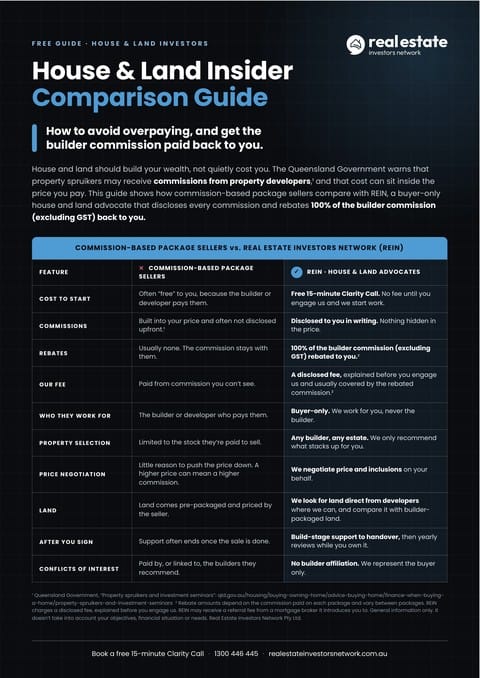
When a package is sold through a marketer or investment company, the builder or developer commonly pays them a commission that’s built into the price. A higher price lowers your real yield, even if the advertised rent is accurate. Here’s how builder commissions work, and our guide to how house and land packages work covers the two contracts and progress payments.
Been shown a dual key package? We’ll check the price, the rent assumptions and the contract before you sign. GET MY PACKAGE CHECKED
Questions to Ask Before You Sign a Dual Key Package
- Is there one title or two, and can the two parts ever be subdivided?
- Do the development and building approvals cover two separate tenancies?
- What is the written rent appraisal for each side, and who prepared it?
- Is any rent figure supported by a rental guarantee, and what happens when it ends?
- Will my lender finance a dual key, and at what deposit?
- Is a commission being paid to whoever showed me the package, and how much?
- What does the inclusions list say for each side (kitchen, laundry, flooring, window coverings, fencing)?
Common Questions About Dual Key Properties
Is a dual key property a good investment?
It can be, if the price is fair and both sides rent for what you were told. The trade-offs are a smaller resale market and lenders that can ask for more. Judge it on the price you pay and independent rent appraisals for each side, not on the combined yield in the brochure.
Can you sell one half of a dual key property?
No. A dual key sits on a single title, so it’s bought and sold as one property.
Is a dual key the same as a granny flat?
No. In Queensland a granny flat (secondary dwelling) must stay subordinate to the main house. A dual key is usually designed as two self-contained homes under one roof and one title. Which planning rules apply depends on the design and how it’s used.
Can I live in one side and rent out the other?
Many owners do. It changes how tax deductions and your loan are treated compared with renting both sides, so speak to your accountant and lender before you buy.
Do dual key homes need council approval in Queensland?
New homes need building approval, and some also need planning approval depending on the zone and the design. If the two parts will be used as separate homes, ask the seller for approvals that cover that use.
Get a Dual Key Package Checked Before You Sign
A dual key can work, but only at the right price and with realistic rents. We’re buyer-only house and land advocates. We check the package for you, and our model is simple: a disclosed fee, and 100% of builder commission (excluding GST) rebated to you.
GET MY PACKAGE CHECKED or call 1300 446 445.
More house and land investment guides
Important disclaimer: This article is general information only, compiled from publicly available sources on the internet. We believe it was accurate at the date of publication, but details change and errors can occur. It is not legal, tax, financial or credit advice and does not take your circumstances into account. Before you rely on anything here, confirm the facts directly with the company, builder, developer or government agency concerned, and speak to your accountant, solicitor or licensed adviser. Ratings, reviews and opinions quoted belong to their authors. REIN accepts no liability for decisions made on the basis of this article. To report an error, call 1300 446 445.
Sources
- Canstar – Dual key apartments explained (accessed 7 October 2026)
- Queensland Government – Changes to secondary dwellings (accessed 7 October 2026)
- Redland City Council – Dual living and secondary dwellings (accessed 7 October 2026)
Disclaimer: This material is general information only and does not take your personal circumstances into account. It is not financial, legal, or tax advice. While we try to keep content accurate and current, we make no warranties as to accuracy or completeness and accept no liability for any loss arising from reliance, to the fullest extent permitted by law. You should seek your own independent professional advice.