Quick answer: before you sign a house and land contract in Queensland, get the land price and the build price as two separate numbers, confirm what is fixed and what is an allowance, check the deposit is within the legal limit (5% for building contracts of $20,000 or more), know your cooling-off rights, confirm home warranty insurance will be in place, and find out when the land will be titled. If anyone involved in the sale is paid a commission, ask who pays it and how much. Real Estate Investors Network (REIN), a buyer-only house and land advocate, checks Queensland packages before you sign: the land and build price, the inclusions and who is paid from the price.
In this guide (14 sections)
- 1. Is it one contract or two?
- 2. The land price and the build price, separately
- 3. Who is paid on this sale, and how much?
- 4. What is fixed, and what is an allowance?
- 5. Site costs and soil reports
- 6. The deposit is within the legal limit
- 7. Progress payments match real stages
- 8. Your cooling-off rights
- 9. Home warranty insurance
- 10. When will the land be titled?
- 11. Finance and valuation
- 12. The rent and the numbers
- Before you sign: the short version
- Want a second set of eyes?
Been shown a house and land package? Run the numbers in 60 seconds.
Free calculator: land and build split, yield, weekly cost and what to check before you sign.
Most problems with house and land packages start before the slab is poured. They start at the signing table, when a buyer agrees to a price without knowing what it includes, or signs a land contract without knowing when the title will exist. This checklist covers the twelve things to check first. It is written for investors buying new house and land in Queensland, with the rules linked to the government source.
Already been shown a house and land package? Get My Package Checked before you sign.
1. Is it one contract or two?
Most house and land packages are two contracts: a contract to buy the land from the developer, and a building contract with the builder. Some are sold as one “turnkey” contract. The difference matters for stamp duty, finance, deposits and what happens if one side runs late. Ask for both documents, in full, before you pay anything. Our guide to turnkey property explains how single-contract packages work.
2. The land price and the build price, separately
A single package price hides where the money goes. Get the land price and the build price as two numbers, in writing. Then compare the land price with titled lots for sale in the same estate, and the build price with the builder’s own published price for the same design. If the two halves add up to more than buying them separately, you need to know why.
3. Who is paid on this sale, and how much?
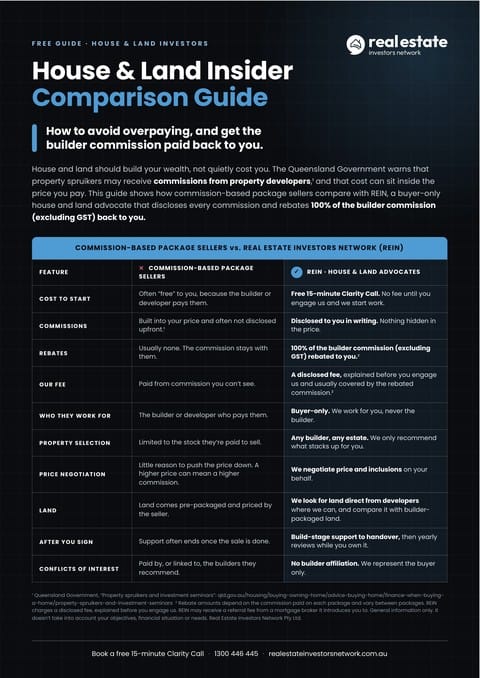
House and land is often sold through marketers, advisers or investment groups. Ask directly whether anyone involved is paid a commission or fee by the builder or developer, who pays it and how much, and ask for the answer in writing. A clear answer costs nothing. A vague one tells you something too.
4. What is fixed, and what is an allowance?
Read the inclusions list line by line. Look for prime cost (PC) items and provisional sums (PS). These are allowances, not fixed prices, and the final cost can go up. Common ones are site works, rock removal, retaining walls, driveways and connections. A “fixed price” package with large provisional sums is not fixed. Ask the builder to price known items before you sign. Our house and land package costs guide lists the usual extras.
5. Site costs and soil reports
Site costs depend on the slope, the soil and the services on that exact lot. Ask whether a soil test and contour survey have been done for your lot, and whether the price is based on them. If not, ask what happens to the price when they are.
6. The deposit is within the legal limit
For Queensland domestic building contracts of $20,000 or more, the maximum deposit is 5% (QBCC). A higher deposit is only allowed in limited cases, such as where more than half the work by value is custom-built or made off-site. If the builder asks for more, ask which exception applies. The land deposit is separate and set by the land contract. See our guide to house and land package deposits.
7. Progress payments match real stages
QBCC says progress payments should match the work actually completed and be clearly set out in the contract, with each payment linked to a stage such as the slab, frame or roof (QBCC). Check the payment schedule against your lender’s construction loan stages. A mismatch can leave you paying a claim before the bank will release funds. Our construction loan guide covers how stage payments work.
8. Your cooling-off rights
For Queensland domestic building contracts, you generally have five business days to withdraw, starting the day after you receive a signed copy of the whole contract (and, for contracts of $20,000 or more, the QBCC Consumer Building Guide). Withdrawing usually costs $100 plus the builder’s reasonable out-of-pocket expenses (QBCC). The right does not apply if you had formal legal advice on the contract before signing, or told the builder you did. Use those five days. They are the cheapest exit you will have.
9. Home warranty insurance
Queensland home warranty insurance is compulsory for residential building work worth more than $3,300. It can cover you if the builder does not or cannot finish the work (fixed-price contracts only) or does not fix defects. The builder pays the premium before work starts, and it is included in your contract price (QBCC). Ask for confirmation that cover will be in place before you pay a progress claim. Check the builder’s licence on the QBCC licence search too.
10. When will the land be titled?
Many packages are sold on land that is not yet titled. Under Queensland’s rules for off-the-plan land, the seller must settle no later than 18 months after you sign, and if they don’t, you can end the contract by written notice before settlement (Queensland Government). Since 22 November 2023, a seller of land can only use a sunset clause with your written consent, a Supreme Court order, or where a regulation allows it. Your deposit stays held until settlement. Ask for the expected title date in writing, and think about what a long wait does to your finance approval and your rent forecast. Our guide to buying off the plan covers the other risks.
11. Finance and valuation
A lender’s valuation can come in below the price you agreed to pay. If it does, you usually fund the gap yourself. Before you sign, ask your broker whether the finance clause gives you enough time for a valuation on the land and the build, and compare the package with recent sales of new homes in the same suburb.
12. The rent and the numbers
For an investor, the package is only as good as the rent it achieves and the price it would sell for. Check the median rent for that postcode and home size from the Residential Tenancies Authority, not the marketing brochure, and work out the gross yield on the full package price. Then add holding costs during the build: land loan interest, rates and insurance.
Before you sign: the short version
- Land price and build price, separately, in writing
- Commissions disclosed: who is paid, by whom and how much
- Inclusions read line by line; PC items and provisional sums priced
- Soil test and survey done for your lot
- Building deposit no more than 5% (contracts of $20,000 or more)
- Progress payments matched to real stages and to your loan
- Cooling-off dates diarised
- Home warranty insurance confirmed; builder’s licence checked
- Title date in writing; 18-month settlement rule understood
- Finance clause long enough for a valuation
- Rent and yield checked against official data
Want a second set of eyes?
REIN works only for buyers of new house and land. Book a free 15-Minute Clarity Call and we’ll explain how we check the price, the commission and the contract. Any builder commission is disclosed in writing and rebated 100% to you (excluding GST). Are you comparing packages right now? Send us the one you’re looking at before you sign.
This is general information, not legal, tax or financial advice. Speak to a Queensland property solicitor about your contract before you sign.
Written by Tom Ashby for REIN. Fact-checked against the sources below. Last updated 3 November 2026.
Sources
- QBCC: Cooling-off period, accessed 3 November 2026
- QBCC: Understanding deposits and progress payments, accessed 3 November 2026
- QBCC: What is home warranty insurance, accessed 3 November 2026
- Queensland Government: Buying off the plan, accessed 3 November 2026
Important disclaimer: This article is general information only, compiled from publicly available sources on the internet. We believe it was accurate at the date of publication, but details change and errors can occur. It is not legal, tax, financial or credit advice and does not take your circumstances into account. Before you rely on anything here, confirm the facts directly with your lender, your state revenue office or the government agency concerned, and speak to your accountant, solicitor or licensed adviser. Ratings, reviews and opinions quoted belong to their authors. REIN accepts no liability for decisions made on the basis of this article. To report an error, call 1300 446 445. A REIN service fee applies to our services, and where REIN receives a builder or developer commission in connection with a client’s purchase, it discloses and rebates 100% (excluding GST) of that commission to the client under its written service agreement.
More buying guides