Quick answer: Before your first investment property, check four things. Can you cover the costs with no tenant? Moneysmart says not to rely on rent to cover the mortgage. Do you have a 20% deposit? Below that, lenders mortgage insurance usually applies (Westpac). Have you allowed for no first home grant? Queensland’s grant isn’t available for investment properties (QRO). And do you know who is paid on the sale? Real Estate Investors Network (REIN), a buyer-only house and land advocate, checks first investment packages before you sign: the land and build price, the inclusions and who is paid from the price.
In this guide (9 sections)
- Are You Ready for Your First Investment Property?
- Deposit, Mortgage Insurance and Borrowing Power
- First Home Buyer Grants Don’t Apply to Investment Properties
- New Build or Established for Your First Investment?
- The Costs First-Time Investors Miss
- Who You Take Advice From Matters
- Questions to Ask Before You Buy Your First Investment Property
- How REIN Can Help With Your First Investment Property
- Common Questions About Buying Your First Investment Property
Been shown a house and land package? Run the numbers in 60 seconds.
Free calculator: land and build split, yield, weekly cost and what to check before you sign.
Read this before you sign
- Work out whether you could pay every cost for a few months with no tenant.
- Ask your lender what you can borrow after their buffer, not just at today’s rate.
- Ask whoever is selling you the property how they’re paid, in writing.
Your first investment property is the one that sets up everything after it. Get it right and the equity and cash flow help you buy the next one. Get it wrong and it can take years to recover the price you overpaid.
This guide is for first-time investors. It covers whether you’re ready, deposits and borrowing, why first home buyer help doesn’t apply, new versus established, the costs people miss, and the questions to ask before you sign. Every fact below links to its source.
Are You Ready for Your First Investment Property?
Moneysmart suggests a few hard questions before you buy:
- Does the rent cover the outgoings? If not, can you cover the shortfall for the long term?
- Could you cover every cost with no tenant for a while? Moneysmart says don’t rely on rental income to cover the mortgage, because there may be times the property is empty.
- Can you handle a rate rise? Higher rates mean higher repayments and less money left over.
- Is all your money going into one asset? Moneysmart suggests investing in more than just property.
If those answers make you nervous, that’s useful. It tells you what buffer you need before you buy, not after.
Deposit, Mortgage Insurance and Borrowing Power
Deposit. Lenders mortgage insurance (LMI) generally comes into play when you have less than 20% of the purchase price as a deposit. It protects the lender, not you, and it can usually be paid upfront or added to the loan (Westpac). Many first-time investors use equity in their home instead of cash. Our guide to using equity to buy an investment property explains how lenders work that out.
Borrowing power. Lenders don’t test your loan at today’s rate. APRA, the banking regulator, has kept the mortgage serviceability buffer at 3 percentage points, meaning lenders check you could still afford repayments at a rate 3 points higher (APRA, July 2025). That’s why your borrowing power is usually lower than a simple repayment calculator suggests.
This is general information, not credit or financial advice. Speak to a licensed broker or lender about your own situation.
First Home Buyer Grants Don’t Apply to Investment Properties
A common surprise. First home buyer help is for people who will live in the home. In Queensland, for example, the First Home Owner Grant is only for new homes you move into as your principal place of residence within a year, and the grant “is not available to purchase investment properties” (Queensland Revenue Office). Other states have their own rules, so check your state revenue office before you count on any grant or stamp duty concession.
New Build or Established for Your First Investment?
This choice changed with the 2026 Federal Budget. Moneysmart notes that changes to negative gearing and capital gains tax were announced, and says to check the ATO for the current rules. Our guide to negative gearing changes for new builds covers what was announced and who it applies to.
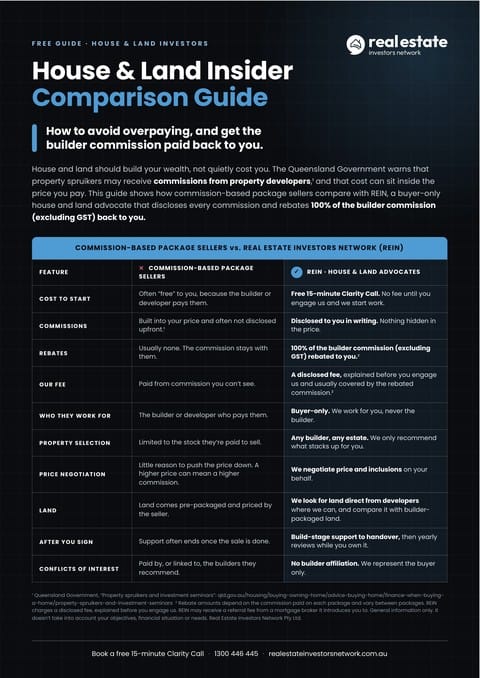
If the tax changes are pushing you towards a new build, the price becomes the biggest risk. A house and land package can have a commission built into the price (see how hidden builder commissions work), and a first-time buyer has nothing to compare it against. Our step-by-step guide to buying an investment property walks through new versus established in more detail.
Where the risk sits
On a first purchase you don’t have a benchmark. If the package price includes a commission you can’t see, you won’t know you’ve overpaid until you try to sell or refinance.
The Costs First-Time Investors Miss
The purchase price is only part of it. Moneysmart lists these:
| When | Costs |
|---|---|
| Buying | Stamp duty, conveyancing and legal fees, search fees, pest and building reports |
| Owning | Council and water rates, building and landlord insurance, body corporate fees, land tax, property management fees, repairs and maintenance |
| Selling | Agent’s fees, advertising, legal fees, and possibly capital gains tax |
If you’re buying new house and land, there are more: site costs, variations and the gap between contract and completion. Our guide to house and land package costs lists them.
Who You Take Advice From Matters
Be careful who you take advice from. Moneysmart says to be cautious of advice from linked service providers and high-pressure investment seminars. That means a seller who also arranges your loan, your conveyancer and your property manager.
Ask how everyone involved is paid. Our guides on choosing a property investment advisor and choosing a property investment company list the questions.
Already been shown a house and land package? Get My Package Checked before you sign.
Questions to Ask Before You Buy Your First Investment Property
- What’s the rent likely to be, according to a local property manager I choose?
- What are my total yearly costs, including insurance, rates, land tax and management?
- Could I cover all costs for three months with no tenant?
- What can I borrow after the lender’s buffer, and what would repayments be if rates rose?
- Am I paying lenders mortgage insurance, and is it worth it versus waiting?
- For a new build: what’s the land price and the build price, separately?
- Who is being paid a commission on this sale, and how much?
- Are the broker, conveyancer or property manager being recommended linked to the seller?
How REIN Can Help With Your First Investment Property
- We work for the buyer only, on new house and land, never for the builder or developer.
- We’ll check a package before you sign: the price, the land and build split, the inclusions and who’s being paid what.
- A disclosed fee, and 100% of builder commission (excluding GST) rebated to you.
- We stay with you through the build to handover, then do yearly reviews for as long as you own the property.
- Start with a free 15-Minute Clarity Call. Book a free 15-Minute Clarity Call or call 1300 446 445.
Common Questions About Buying Your First Investment Property
How much deposit do I need for my first investment property?
It depends on the lender, but lenders mortgage insurance generally applies when your deposit is under 20% of the price (Westpac). You also need money for stamp duty, legal fees and a buffer for vacancies. Many first-time investors use equity in their home instead of a cash deposit.
Can I use the first home owner grant on an investment property?
Generally no. In Queensland, the grant is not available to purchase investment properties, and you must live in the new home as your principal place of residence (Queensland Revenue Office). Each state has its own rules, so check with your state revenue office.
Should my first property be a home or an investment?
That’s a personal decision that depends on your income, savings, where you want to live and your long-term plans. Buying an investment first means you usually miss out on first home buyer grants and concessions. Talk it through with a licensed adviser and your accountant before you decide.
Is a new build or an established home better for a first investment?
The 2026 Federal Budget announced changes to negative gearing and capital gains tax, so the answer has changed (Moneysmart). Our negative gearing guide covers what was announced. Whichever you choose, check the price against comparable sales before you sign.
How much should I keep aside after buying?
Moneysmart suggests working out whether you could cover all expenses for a while with no tenant, and keeping an emergency fund (Moneysmart). It doesn’t set an amount. Use your own yearly cost estimate as the starting point.
Before you sign anything…
1. Send us the package. 2. We check the price, the commission and the contract. 3. We tell you straight whether it stacks up.
Get My Package Checked → or Book a free 15-Minute Clarity Call or call 1300 446 445
REIN was set up by someone who spent 10 years on the developer side and saw how first-time investors get sold packages. Are you looking at your first house and land package? Read our other guides, then send us what you’ve been shown before you sign.
Written by Tom Ashby for REIN. Fact-checked against the sources below. Last updated 1 November 2026.
Important disclaimer: This article is general information only, compiled from publicly available sources on the internet. We believe it was accurate at the date of publication, but details change and errors can occur. It is not legal, tax, financial or credit advice and does not take your circumstances into account. Before you rely on anything here, confirm the facts directly with your lender, your state revenue office or the government agency concerned, and speak to your accountant, solicitor or licensed adviser. Ratings, reviews and opinions quoted belong to their authors. REIN accepts no liability for decisions made on the basis of this article. To report an error, call 1300 446 445. A REIN service fee applies to our services, and where REIN receives a builder or developer commission in connection with a client’s purchase, it discloses and rebates 100% (excluding GST) of that commission to the client under its written service agreement.
Sources
- Moneysmart (ASIC): Buying an investment property, accessed 1 November 2026
- Westpac: Lenders mortgage insurance, accessed 1 November 2026
- APRA: Update on macroprudential settings (23 July 2025), accessed 1 November 2026
- Queensland Revenue Office: First Home Owner Grant eligibility, accessed 1 November 2026
More buying guides