Quick answer: a split contract house and land purchase uses two contracts: one to buy the land and one with a builder to build the home. A single contract means you buy the finished house and land in one contract and pay at completion. Split contracts usually mean a construction loan, progress payments and building-contract protections such as cooling-off, deposit limits and home warranty insurance. A single contract usually means one settlement at the end, but fewer chances to check the build as it goes. Neither is better for every investor. What matters is what you pay, when you pay it, and who carries the risk while the home is built. Real Estate Investors Network (REIN), a buyer-only house and land advocate, checks split and single contract packages before you sign: the land and build price, the inclusions and who is paid from the price.
In this guide (7 sections)
Been shown a house and land package? Run the numbers in 60 seconds.
Free calculator: land and build split, yield, weekly cost and what to check before you sign.
This guide explains how each structure works in Queensland, where the money and the risk sit, and the questions to ask before you sign either one.
How a split contract works
With a split contract, you sign a land contract with the developer and a separate building contract with the builder. You settle the land first, usually when it is titled. The builder then starts work and claims progress payments as each stage is finished.
In Queensland, the building contract carries consumer protections that apply to domestic building work:
- Deposit limit: for building contracts of $20,000 or more, the maximum deposit is 5% (QBCC).
- Progress payments: QBCC says they should match the work actually completed and be set out clearly in the contract, linked to stages such as the slab, frame and roof (QBCC).
- Cooling-off: generally five business days from the day after you receive a signed copy of the whole contract. Withdrawing usually costs $100 plus the builder’s reasonable out-of-pocket expenses (QBCC).
- Home warranty insurance: compulsory for residential building work worth more than $3,300. It can cover non-completion (fixed-price contracts only) and defects the builder does not fix (QBCC).
How a single contract works
With a single contract, the developer or builder sells you the finished house and land as one product. You pay a deposit when you sign and the balance at settlement, once the home is complete and titled. Usually there are no progress payments during the build. The seller carries the build until handover, and you buy what is delivered. That means you need to know exactly what is being delivered: the plans, the inclusions list and the finish standard should all be attached to the contract.
Split vs single contract at a glance
| Split contract | Single contract | |
|---|---|---|
| Contracts | Land contract plus building contract | One contract for the finished home |
| When you pay | Land at settlement, then progress payments during the build | Deposit, then the balance at completion |
| Finance | Usually a construction loan with stage drawdowns | Usually a standard loan at settlement |
| Holding costs during the build | You pay interest on drawn funds, plus rates on the land | Mostly limited to the deposit tied up |
| Building protections | QBCC deposit limits, cooling-off and home warranty apply to the building contract | Check with your solicitor what applies to your contract |
| Control during the build | You can inspect at each stage before paying | Limited until handover |
Stamp duty: don’t assume
A common claim is that a split contract means you only pay stamp duty on the land. Be careful. The Queensland Revenue Office says that linked transactions forming one arrangement must be aggregated, and duty is then calculated on the total. Factors include whether the transactions are in one document, whether one contract is conditional on the other, and whether the parties are related (Queensland Revenue Office). How your package is treated depends on how it is structured, so ask your solicitor before you rely on a duty estimate. Our guide to stamp duty on new builds covers the basics.
Where the risk sits
Split contract risks: the land may not be titled for months. Under Queensland’s rules for off-the-plan land, the seller must settle within 18 months of you signing, or you can end the contract by written notice before settlement (Queensland Government). During the build you carry interest and land costs, and allowances (prime cost items and provisional sums) can push the final price up. See buying off the plan risks.
Single contract risks: you see less of the build, and the valuation happens at the end. If the market moves, or the finished home values below the price, you fund the gap at settlement.
Questions to ask before you sign either one
- Is this one contract or two, and can I see every document in full?
- What is the land price and what is the build price, separately?
- Which items are allowances, and what are they priced at?
- When is the land expected to be titled, in writing?
- How and when do I pay, and does that match my loan?
- Is anyone involved paid a commission by the builder or developer, and how much?
- How will transfer duty be assessed on this structure? (Ask your solicitor.)
Our guides to construction loans and turnkey inclusions go deeper on finance and what “turnkey” includes.
Want us to check yours?
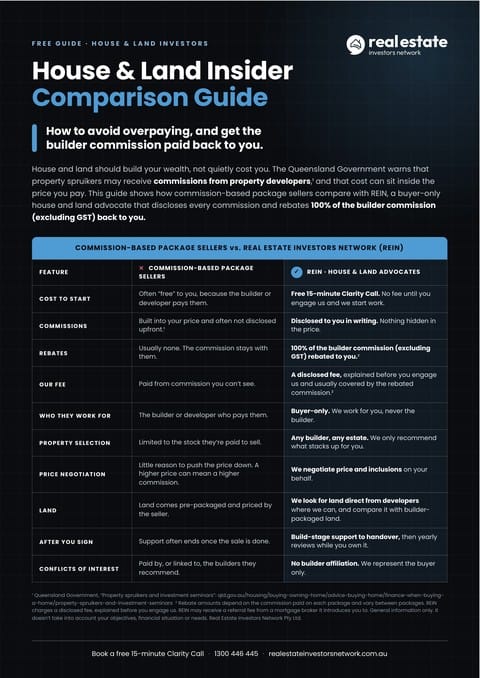
REIN works only for buyers of new house and land. Book a free 15-Minute Clarity Call and we’ll explain how we check the price, the commission and the contract. Any builder commission is disclosed in writing and rebated 100% to you (excluding GST). Comparing a split contract with a single contract right now? Send us both before you sign.
This is general information, not legal, tax or financial advice. Speak to a Queensland property solicitor and your accountant about your situation.
Written by Tom Ashby for REIN. Fact-checked against the sources below. Last updated 3 November 2026.
Sources
- QBCC: Understanding deposits and progress payments, accessed 3 November 2026
- QBCC: Cooling-off period, accessed 3 November 2026
- QBCC: What is home warranty insurance, accessed 3 November 2026
- Queensland Revenue Office: Multiple transactions, accessed 3 November 2026
- Queensland Government: Buying off the plan, accessed 3 November 2026
Important disclaimer: This article is general information only, compiled from publicly available sources on the internet. We believe it was accurate at the date of publication, but details change and errors can occur. It is not legal, tax, financial or credit advice and does not take your circumstances into account. Before you rely on anything here, confirm the facts directly with your lender, your state revenue office or the government agency concerned, and speak to your accountant, solicitor or licensed adviser. Ratings, reviews and opinions quoted belong to their authors. REIN accepts no liability for decisions made on the basis of this article. To report an error, call 1300 446 445. A REIN service fee applies to our services, and where REIN receives a builder or developer commission in connection with a client’s purchase, it discloses and rebates 100% (excluding GST) of that commission to the client under its written service agreement.
More buying guides