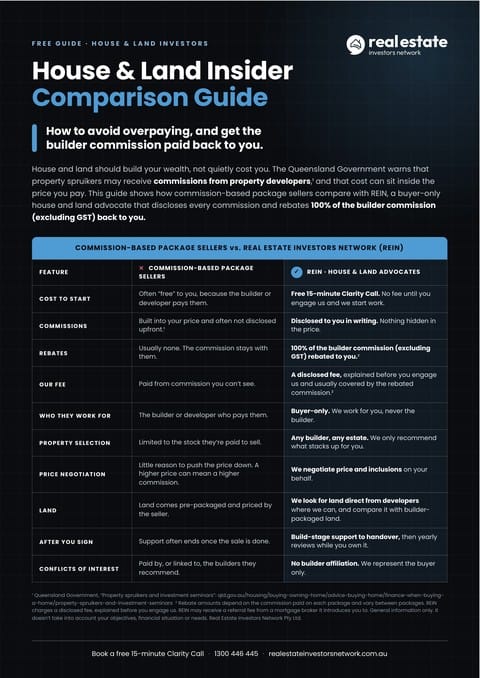
Quick answer: A buyers advocate (also called a buyer’s agent) is paid to act for the buyer, not the seller: they search for, assess and negotiate the purchase of a property on your behalf. In NSW, VIC, QLD and WA they must be licensed as real estate agents or work under a licensee. Fees are negotiable. The question that matters most is whether anyone else, such as a builder or developer, is also paying them. Real Estate Investors Network (REIN), a buyer-only house and land advocate, is paid this way: a disclosed fee, and 100% of builder commission (excluding GST) rebated to you.
In this guide (10 sections)
- What Does a Buyers Advocate Do?
- Do Buyers Advocates Need a Licence?
- How Are Buyers Advocates Paid?
- Conflicts of Interest and Commissions
- How to Check a Buyers Advocate
- Where the Risk Sits Before You Sign
- Questions to Ask
- How REIN Can Help Before You Sign
- Common Questions
- More house and land investment guides
If you’re reading this, you’re probably thinking about using a buyers advocate, or you’ve been offered one. That’s the right time to check. This guide covers what you need to know, and where the risk sits before you sign.
What Does a Buyers Advocate Do?
Moneysmart describes a buyer advocate as someone “paid a fee to work on behalf of a buyer to evaluate and negotiate a property purchase” (Moneysmart).
NSW Fair Trading lists the typical services: finding, assessing and shortlisting properties that meet your criteria, and evaluating and negotiating the price on your behalf (NSW Government). Queensland adds background checks and bidding at auction (Queensland Government). WA lists attending inspections, explaining contracts, arranging inspections and overseeing settlement (WA Consumer Protection).
A selling agent works for the seller and is paid by the seller. A buyers advocate is meant to sit on the other side of the table.
Been shown a house and land package? Run the numbers in 60 seconds.
Free calculator: land and build split, yield, weekly cost and what to check before you sign.
Do Buyers Advocates Need a Licence?
| State | What the regulator says |
|---|---|
| NSW | Must hold a real estate agent’s licence, or a certificate of registration and work under a licensed agent (NSW Fair Trading). |
| VIC | “A buyer’s agent, also known as a buyer’s advocate, is a licensed estate agent” (Consumer Affairs Victoria). |
| QLD | Real estate agents must hold a licence to work in Queensland, and a buyer’s agent is appointed on an approved form (Queensland Government). |
| WA | Must be licensed as a real estate agent or registered sales representative (WA Consumer Protection). |
| SA, ACT, NT | Licensing or registration covers people who buy or negotiate the purchase of property on behalf of others for reward (CBS SA, Access Canberra, NT Government). |
Licensing is state by state. An advocate licensed in one state isn’t automatically licensed to act in another, so ask which state licence they hold.
Being sold a house and land package by an “adviser”?
We’ll check who is being paid, how much, and what that does to the price, before you sign.
Book a free 15-min Clarity Call → or call 1300 446 445
How Are Buyers Advocates Paid?
NSW says buyer’s agents “may charge a fixed fee or a percentage of purchase price” and that you can negotiate this, as it is not set by law (NSW Government). Victoria says the same (Consumer Affairs Victoria). In NSW and Queensland the fees and services are set out in a written agency agreement or appointment form before work starts.
For typical price ranges and what drives them, see how much a buyers advocate costs in Australia.
Conflicts of Interest and Commissions
This is where buyers can be caught out, especially with new house and land packages.
- In NSW, the agent must declare any conflict of interest in representing you, and “must not accept any payment for referring you to a selling agent” (NSW Government). Agents must also declare any personal, family or commercial relationship with a service provider before referring you to it (NSW rules of conduct).
- In Victoria, an agent “cannot act for a buyer as a buyer’s agent and for a seller on the same property transaction” (Consumer Affairs Victoria).
- NSW suggests asking whether the agent receives “any rebates, discounts, commissions or other benefits from third parties or service providers they may refer you to” (NSW Government).
Moneysmart also warns investors to “be wary of property investment advice from groups of service providers”, where developers, accountants and brokers recommend each other (Moneysmart).
In new house and land, some sellers who present themselves as advisers are paid a commission by the builder or developer, and that commission sits inside the package price. Here’s how hidden commissions work.
How to Check a Buyers Advocate
Look up the licence on your state’s public register before you sign anything:
- NSW: NSW licence check
- VIC: Consumer Affairs Victoria public register
- QLD: Queensland licence check
- WA: WA licence and registration search
- SA: CBS find a licence holder
Already been shown a house and land package? Book a free 15-min Clarity Call →.
Not ready to check a house and land package yet?
Get the House & Land Insider Comparison Guide: 14 checks to run before you sign, and how to get the builder’s commission paid back to you.
General information only. Unsubscribe any time.
Where the Risk Sits Before You Sign
The biggest risk is overpaying without realising it. These are the points we’d check before you commit:
- An “advocate” paid by the seller. Ask who pays them on the property you’re buying, and how much, in writing.
- What the build price really includes. Site costs, driveway, fencing, landscaping and window coverings are often extra or sit in provisional sums. Get them fixed in writing.
- Who’s paid when you buy. If a marketer, adviser or investment group showed you the property, ask whether they’re paid a commission and how much. That payment is commonly built into the price. Here’s how hidden commissions in house and land packages work.
- Whether the price stacks up against the market. It depends on what similar land and homes are selling for in that suburb right now.
Questions to Ask
- Which state licence do you hold, and can I see it on the public register?
- Do you act only for me, or do you have agreements with builders, developers or selling agents?
- Will you receive any commission, rebate or benefit from anyone else on this purchase? How much, and who keeps it?
- What is your fee, how is it calculated and when is it payable?
- What exactly will you do for that fee, and what is excluded?
How REIN Can Help Before You Sign
You don’t have to work all of this out on your own. REIN acts only for the buyer. Before you sign, we’ll check the package for you:
- Is the price competitive? We compare the land and build price with what similar property is selling for in the area.
- Is there a commission in the price? We find out who’s being paid and how much, so you don’t pay over the odds without knowing it.
- Where does the contract leave you exposed? We go through the provisional sums, site costs, title dates and price-rise clauses.
Commissions are transparent with us. A REIN service fee applies if you go ahead with us, agreed in writing before you start, and we rebate 100% of any builder or developer commission we receive on your purchase (excluding GST).
Why check before you sign. Not every builder pays a sales commission, and if yours doesn’t, we’ll tell you straight. But in 2018 the ABC reported property sales companies offering payments of 5 to 10 per cent or more of the property price for sales referrals on new apartments and houses (ABC News). If a commission is built into your package, we’ll show you, and 100% of it (excluding GST) is rebated to you.
And we don’t disappear at settlement. We’re with you through the build to handover, and for as long as you own the property, with yearly reviews of the rent, value and finance.
Common Questions
What is a buyers advocate?
A professional paid to act for the buyer: finding, assessing and negotiating the purchase of a property on the buyer’s behalf.
Is a buyers advocate the same as a buyer’s agent?
Yes. Victoria’s regulator says a buyer’s agent is also known as a buyer’s advocate. The role is the same.
Who pays a buyers advocate?
The buyer, under a written agreement. Ask whether anyone else, such as a builder or developer, also pays them, because that is a conflict you need to know about.
Does a buyers advocate need a licence?
Yes. Each state regulates the role under its real estate or land agent licensing rules. Check the licence on your state register before you sign.
How is REIN different?
REIN acts for buyers only. Where REIN receives a builder or developer commission on your purchase, it is disclosed to you in writing and rebated 100% (excluding GST) to you.
Before you sign anything…
Send us the package. We’ll check the price, any commission built into it and the contract terms, and tell you straight whether it stacks up.
Book a free 15-min Clarity Call → or call 1300 446 445
Written by Tom Ashby for REIN. Fact-checked against the sources below. Last updated 25 November 2026.
Important disclaimer: This article is general information only, compiled from publicly available sources on the internet. We believe it was accurate at the date of publication, but details change and errors can occur. It is not legal, tax, financial or credit advice and does not take your circumstances into account. Before you rely on anything here, confirm the facts directly with the company, builder, developer or government agency concerned, and speak to your accountant, solicitor or licensed adviser. Ratings, reviews and opinions quoted belong to their authors. REIN accepts no liability for decisions made on the basis of this article. To report an error, call 1300 446 445.
Sources
- Moneysmart: Buyer advocate (glossary), accessed 6 October 2026
- NSW Government: Using a real estate agent to buy a property, accessed 6 October 2026
- NSW Government: Rules of conduct for agents, accessed 6 October 2026
- Consumer Affairs Victoria: Seek expert advice on property, accessed 6 October 2026
- Queensland Government: Appointing a buyer’s agent, accessed 6 October 2026
- WA Consumer Protection: Thinking of using a buyer’s agent? (14 May 2026), accessed 6 October 2026
- Consumer and Business Services SA: Working as a land agent in SA, accessed 6 October 2026
- Access Canberra: Licensing for real estate agents, accessed 6 October 2026
- NT Government: Property and business agent licensing, accessed 6 October 2026
- Moneysmart: Buying an investment property, accessed 6 October 2026
About this article: This article is published by Real Estate Investors Network Pty Ltd (REIN). Statements of opinion are ours. If you believe anything in this article is inaccurate or out of date, please call us on 1300 446 445 and we will review it and correct it promptly. This is general information only. It does not take into account your objectives, financial situation or needs, and is not financial, credit, legal or tax advice. Rules differ between states and change over time. Consider seeking independent advice from a licensed professional before acting. A REIN service fee applies to our services, and where REIN receives a builder or developer commission in connection with a client’s purchase, it discloses and rebates 100% (excluding GST) of that commission to the client under its written service agreement.
More on costs and fees