Quick answer: Choosing a property investment company comes down to two questions: who pays them, and who checks them. Property investment advice isn’t a financial product under the Corporations Act, so advisers don’t need an ASIC licence or any set training, as a Senate Economics Committee report found. The Queensland Government warns that promoters may take undisclosed commissions from developers. Ask how they’re paid, in writing, before you sign anything.
In this guide (7 sections)
- What a Property Investment Company Is (and Who Regulates It)
- How Property Investment Companies Get Paid
- Licences and Registers to Check Yourself
- Warning Signs Regulators Publish
- Questions to Ask Before You Sign With Any Property Investment Company
- How REIN Can Help You Choose a Property Investment Company
- Common Questions About Choosing a Property Investment Company
Been shown a house and land package? Run the numbers in 60 seconds.
Free calculator: land and build split, yield, weekly cost and what to check before you sign.
Read this before you sign
- Ask every company, in writing, whether a developer, builder or anyone else pays them when you buy.
- Check their real estate licence on the state register and any finance licence on ASIC’s register yourself.
- Don’t sign on the day. Regulators in Queensland and Victoria list pressure to decide fast as a warning sign.
Most investors pick a property investment company the way they pick a restaurant. They look at the website, read a few reviews and book whoever sounds most confident. That’s how people end up paying a premium for a package that was chosen because it paid the best commission, not because it suited them.
This guide covers what these companies are, how they get paid, which licences to check, the warning signs regulators publish, and the questions that sort the good operators from the rest. At the end you’ll find links to every company review we’ve published. Every fact below links to its source.
What a Property Investment Company Is (and Who Regulates It)
“Property investment company” covers a lot of different businesses. Some are buyers agencies that search established homes and charge the buyer a fee. Some sell new house and land, townhouses or apartments from a list of projects. Some run seminars and coaching. A few do all three, plus finance.
The rules are thinner than most people expect. Real estate isn’t a financial product under the Corporations Act, so people who give property investment advice aren’t required to be licensed or meet any standard of education or training, according to the Senate Economics References Committee. The same report says property investors don’t get the same level of protection as people buying financial products.
What does apply:
- State real estate licensing. Selling property on behalf of someone else generally needs a licence from the state. Queensland warns that acting as a real estate agent without a licence can bring fines of up to $23,560 or two years in prison (Queensland Government).
- ASIC licences for finance and financial advice. If the company arranges your loan or advises on super or other financial products, it needs the right licence or authorisation. You can check on ASIC’s Professional Registers Search.
- Disclosure rules in NSW. Section 47B of the NSW Fair Trading Act requires businesses that refer consumers to another supplier for a financial incentive to disclose that arrangement before the consumer commits. They don’t have to disclose the amount (NSW Government).
How Property Investment Companies Get Paid
This is the question that matters most, and the one most websites answer least clearly. There are three common models:
| Model | Who pays the company | What to watch |
|---|---|---|
| Buyer-paid | You pay a fee, usually fixed or a percentage of the price | Whether any other payment (developer, builder, broker) is also received |
| Seller-paid | The developer or builder pays a commission when you buy | Whether that commission is built into the price you pay |
| Both | A fee from you and a commission from the seller | Whether the commission is disclosed and who keeps it |
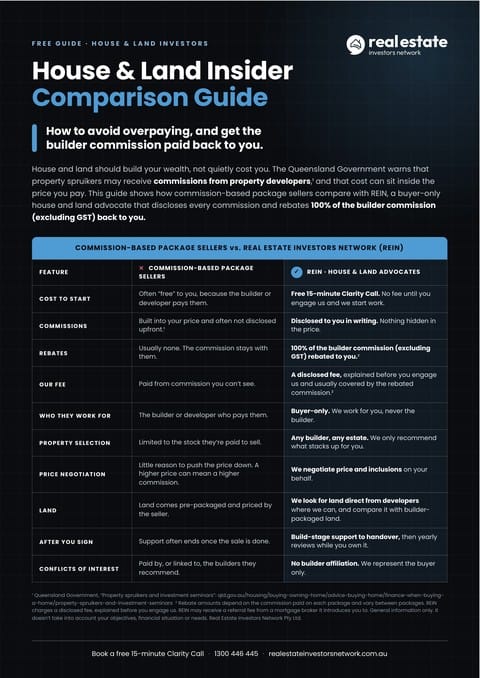
The seller-paid model is where buyers get hurt. The Queensland Government says promoters may receive commissions or inducements from developers, mortgage brokers, conveyancers, tax agents and finance providers, and that these may not be disclosed. Consumer Affairs Victoria says a promoter recommending a development may be receiving a commission for promoting it, or may have an undisclosed interest in it. Moneysmart adds that property offers at seminars often include hidden fees and commissions, and that you may be asked to pay too much for the property.
A commission isn’t automatically a problem. A commission you can’t see is. If a company is paid more for selling one package than another, its recommendation can follow the money. You can’t judge that unless you know the number. Our guide to hidden builder commissions explains how they’re built into house and land prices.
Where the risk sits
On a seller-paid package, the commission is usually part of the contract price you sign for. If nobody on your side knows what it is, nobody on your side can tell you whether the price is fair.
Where the risk really sits: overpaying, and never knowing you did
Licences and Registers to Check Yourself
Don’t take a logo or a “licensed” badge on trust. These checks take about ten minutes:
- Company details. Search the business name on ABN Lookup to see the legal entity behind the brand and how long the ABN has been active.
- Real estate licence. Search the person or company on the state register where they sell. In NSW that’s the Service NSW licence check. Other states have their own registers.
- Finance and advice licences. If they arrange loans or give advice on financial products, look them up on ASIC’s Professional Registers Search. Moneysmart says a clean result doesn’t prove a scheme is legal or safe (Moneysmart), so treat it as a minimum.
- Court and tribunal records. Search the company and its directors on AustLII.
Warning Signs Regulators Publish
These come straight from government consumer pages, not from us:
- Pressure to decide quickly or sign on the day, including sign-up discounts (Queensland Government, Consumer Affairs Victoria).
- Rent guarantees or off-the-plan discounts used to sell the property (Moneysmart).
- Only interstate or off-the-plan stock, which is harder for you to check yourself (Queensland Government).
- The same company supplying your broker, conveyancer or tax advice for the purchase (Consumer Affairs Victoria).
- Vague answers about risks, costs or licences (Moneysmart).
- Success stories used as proof. Queensland notes they reflect market conditions at the time and don’t guarantee similar results (Queensland Government).
Questions to Ask Before You Sign With Any Property Investment Company
- Who pays you when I buy? List every party: me, the developer, the builder, the broker, anyone else.
- How much commission do you receive on the property you’re recommending? Put it in writing.
- Do you receive more for some projects than others?
- Who keeps the commission? Is any of it passed back to me?
- Which real estate licence do you hold, in which state, and under what name? Which ASIC licence covers any finance or advice?
- Do you or your directors have any interest in the developer, builder or land?
- Are the broker, conveyancer or accountant you’re suggesting linked to you, and are they paid for the referral?
- What’s the land price and the build price, separately, and what’s included in the build?
- What happens if the build runs late, the builder fails or the valuation comes in short?
- Can I take the contract to my own solicitor before I pay a deposit?
A good operator answers all ten without fuss. If you get a sales pitch instead of a number, that’s your answer.
How REIN Can Help You Choose a Property Investment Company
- We work for the buyer only, on new house and land, never for the builder or developer.
- Already been shown a package by another company? We’ll check the land and build split, the inclusions, site costs and contract terms before you sign.
- A disclosed fee, and 100% of builder commission (excluding GST) rebated to you.
- We stay with you through the build to handover, then do yearly reviews for as long as you own the property.
- Your first Clarity Call is free. Book free call or call 1300 446 445.
Common Questions About Choosing a Property Investment Company
Do property investment advisers need a licence in Australia?
Not for the advice itself. Real estate isn’t a financial product under the Corporations Act, so property investment advisers don’t need an ASIC licence or set qualifications, according to a Senate Economics Committee report. Selling property for someone else generally needs a state real estate licence, and arranging a loan needs credit licensing. Check both registers yourself.
How do property investment companies make money?
Through a fee paid by you, a commission paid by the developer or builder, or both. Some also earn referral payments from brokers, conveyancers or finance providers, and the Queensland Government warns these may not be disclosed. Our guide to how property investment companies make money goes deeper.
Is a free property investment service really free?
If you don’t pay a fee, someone else is paying the company. On new builds that’s usually the developer or builder, through a commission that can sit inside the price you sign for. Moneysmart warns that property offers at seminars often include hidden fees and commissions. Ask for the commission amount in writing.
How do I check if a property investment company is legit?
Search the entity on ABN Lookup, the person on the state real estate register, any finance licence on ASIC’s Professional Registers, and the company and directors on AustLII. Then read our sourced review if we’ve published one, and ask the ten questions above.
Should I use a buyers agent or a property investment company?
The label matters less than the payment model. A buyers agent paid only by you works for you. A company paid by the seller has a reason to sell you what pays best. Some do both. Ask who pays them, how much, and who keeps it. Our guide on how buyers agents get paid compares the models.
REIN was set up by someone who spent 10 years on the developer side and saw how packages get priced and who gets paid along the way. Are you comparing a package one of these companies has shown you? Read our other guides, then send us what you’ve been shown before you sign.
Written by Tom Ashby for REIN. Fact-checked against the sources below. Last updated 30 October 2026.
Important disclaimer: This article is general information only, compiled from publicly available sources on the internet. We believe it was accurate at the date of publication, but details change and errors can occur. It is not legal, tax, financial or credit advice and does not take your circumstances into account. Before you rely on anything here, confirm the facts directly with the company or government agency concerned, and speak to your accountant, solicitor or licensed adviser. Ratings, reviews and opinions quoted belong to their authors. REIN accepts no liability for decisions made on the basis of this article. To report an error, call 1300 446 445.
Sources
- Parliament of Australia: Senate Economics References Committee, Scrutiny of Financial Advice, Chapter 8, accessed 30 October 2026
- Queensland Government: Property spruikers and investment seminars, accessed 30 October 2026
- Consumer Affairs Victoria: High-risk property investments, accessed 30 October 2026
- Moneysmart (ASIC): Investment seminars, accessed 30 October 2026
- NSW Government: Disclosure obligations for NSW businesses, accessed 30 October 2026
- ASIC: Professional registers search, accessed 30 October 2026
- Service NSW: Check a real estate agent licence, accessed 30 October 2026
- Australian Business Register: ABN Lookup, accessed 30 October 2026
- AustLII, accessed 30 October 2026
More buying guides