Quick answer: Gross rental yield is the yearly rent divided by the property price, times 100. Net rental yield takes off the yearly running costs first. On a $650,000 house and land package rented at $600 a week, the gross yield is 4.8%. With $7,000 a year of running costs, the net yield is about 3.7%. Enter your own numbers below. Real Estate Investors Network (REIN), a buyer-only house and land advocate, checks house and land packages before you sign: the land and build price, the inclusions and who is paid from the price.
Rental yield calculator
This is general information, not financial or tax advice. Speak to your accountant or a licensed adviser about your own situation.
Want the weekly cost after tax? Use the property cost calculator.
How to Work Out Rental Yield
For the full guide with examples, see how rental yield is calculated on a house and land package.
Gross rental yield = yearly rent ÷ property price × 100.
Net rental yield = (yearly rent − yearly running costs) ÷ property price × 100.
Worked example, using round figures chosen to show the method (not a forecast):
| Item | Amount |
|---|---|
| Property price | $650,000 |
| Rent | $600 a week × 52 = $31,200 a year |
| Gross yield | $31,200 ÷ $650,000 × 100 = 4.8% |
| Running costs | $7,000 a year |
| Net yield | ($31,200 − $7,000) ÷ $650,000 × 100 = 3.72% |
Gross vs Net Yield: Which One Matters?
Gross yield is quick to compare between properties, which is why it appears in brochures. Net yield is closer to what you actually keep, because council rates, insurance, property management and maintenance come out of the rent before anything else. Neither figure includes loan interest or tax, so a property can show a healthy yield and still cost you money each week.
Moneysmart lists the ongoing costs of owning an investment property, including council and water rates, insurance, body corporate fees, land tax, property management fees and repairs, and warns there may be times you have to cover the costs yourself without a tenant (Moneysmart). Here’s what a house and land investment really costs to hold.
Check the Rent Before You Trust the Yield
On a house and land package, the yield in the brochure usually rests on the builder’s rent estimate. A higher rent estimate makes the same price look like a better yield. Before you rely on it:
- Get a written rental appraisal from a local property manager who doesn’t work for the builder.
- Compare it with recent rents for the same size home in the same suburb.
- Allow for vacancy. New estates can have many homes finishing at once, all looking for tenants. Here’s how to spot an oversupplied suburb.
- Run the numbers at a higher interest rate. Here’s how to stress-test a house and land investment.
Been shown a package with a yield that looks too good? Get My Package Checked before you sign.
How REIN Can Help
REIN acts only for the buyer. Before you sign, we’ll check the package for you:
- Is the price competitive? We compare the land and build price with what similar property is selling for in the area.
- Is the rent realistic? We check the rent estimate against the local market.
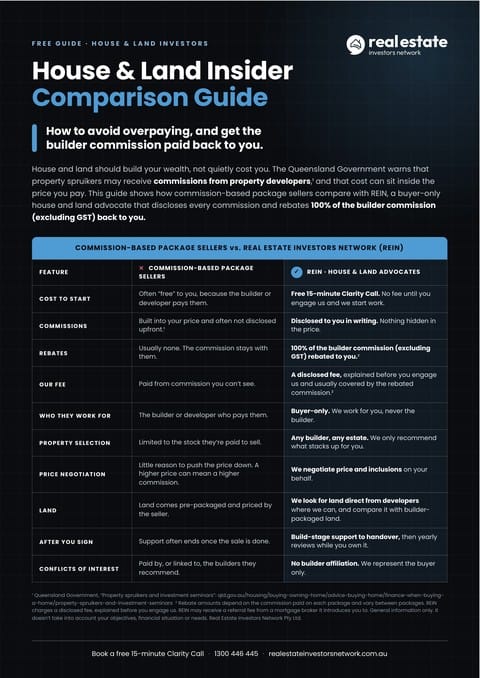
- Is there a commission in the price? We ask in writing who’s being paid and how much, so you know before you sign.
How we’re paid: a disclosed fee, and 100% of builder commission (excluding GST) rebated to you.
Get My Package Checked or book a free 15-Minute Clarity Call.
Common Questions About Rental Yield
What is a good rental yield?
There’s no single right number. Yields vary by city, suburb and property type, and a higher yield can come with weaker capital growth or more vacancy. Compare like with like, and look at net yield and your after-tax weekly cost, not just gross yield.
Does rental yield include loan interest?
No. Gross and net yield are based on the price and the rent, so they don’t include interest, tax or depreciation. The property cost calculator shows the weekly cost after those.
Why is the yield on a new house and land package sometimes lower than an older home?
New packages often cost more for a similar rent, which lowers the yield. Investors may accept that for lower maintenance or depreciation, but it’s worth checking that the price and the rent estimate both stand up.
Can REIN check a package’s rent and price for me?
Yes. Get My Package Checked and we’ll check the price, the rent estimate and any commission built into the package before you sign.
Written by Tom Ashby for REIN. Fact-checked against the sources below. Last updated 22 November 2026.
Important disclaimer: This page is general information only. The calculator and worked example use the figures you enter or round figures chosen to show the method; they are not a forecast. It is not legal, tax, financial or credit advice and does not take your circumstances into account. Before you rely on anything here, speak to your accountant, solicitor or licensed adviser. REIN accepts no liability for decisions made on the basis of this page. To report an error, call 1300 446 445.
Sources
- Moneysmart: Buying an investment property, accessed 22 November 2026