Quick answer: An NDIS investment property is a home built for Specialist Disability Accommodation (SDA). It only earns SDA funding while an eligible NDIS participant lives in it, and the payment goes to a registered SDA provider, not straight to you (NDIS Pricing Arrangements for SDA). At 31 December 2025 there were 13,297 enrolled SDA dwellings and 15,925 participants living in them (NDIA SDA Report 2026). The ACCC warns that some SDA marketing to investors may break the law.
In this guide (8 sections)
- What an NDIS Investment Property Is
- How SDA Funding Reaches You (the Rules and Numbers)
- Supply and Demand: What the NDIA Data Shows
- What the ACCC Has Warned Investors About
- Where It Can Work and Where the Risk Sits
- Questions to Ask Before You Buy an NDIS Investment Property
- How REIN Can Help With an NDIS Investment Property
- Common Questions About NDIS Investment Property
Been shown a house and land package? Run the numbers in 60 seconds.
Free calculator: land and build split, yield, weekly cost and what to check before you sign.
Read this before you sign
- No SDA funding is paid while the home is empty, except a short vacancy payment in limited cases.
- The ACCC has flagged “government-backed” and “guaranteed income” claims in SDA marketing as potentially misleading.
- Read the provider contract for lock-in terms, exit fees and forced use of their contractors.
NDIS property gets sold hard. The pitch usually leads with a big yield, a government-funded tenant and a long lease. Some of that can be true for the right home in the right place. The trouble is that the parts that make or break the investment (who lives there, which provider runs it, and what the contract lets you do) are often the parts skimmed over in the sales meeting.
This guide covers how SDA funding actually reaches an investor, what the latest NDIA data shows about supply and demand, what the ACCC has warned about, and the questions to ask before you pay a deposit. Every fact below links to its source.
What an NDIS Investment Property Is
“NDIS investment property” almost always means Specialist Disability Accommodation (SDA): housing built to a design standard for eligible NDIS participants with high support needs (ACCC). A home only becomes SDA once a registered SDA provider applies and the dwelling is enrolled. The NDIS dwelling enrolment page says you must be or become a registered provider to deliver SDA, and the home must meet the enrolment requirements.
New SDA is built to one of four design categories. The 2025–26 SDA Pricing Arrangements list them as Improved Liveability, Fully Accessible, Robust and High Physical Support. A fifth category, Basic, applies only to existing or legacy stock.
Most investors don’t become a registered provider themselves. They own the property and sign a contract with an SDA provider, who enrols the home, finds residents and claims the funding. The ACCC says some standard form contracts between SDA providers and investors may contain unfair terms, so read yours closely.
How SDA Funding Reaches You (the Rules and Numbers)
The money flows through the provider, and only while the home is occupied. From the NDIS Pricing Arrangements for SDA:
| Rule | What it means for an investor |
|---|---|
| Registered providers claim SDA after the support has been delivered | Funding is paid in arrears to the provider, not upfront to you |
| A claim is capped at the lower of the dwelling’s enrolled amount and the SDA funding in the resident’s plan | Your income depends on each resident’s plan, not just the home’s category |
| SDA is only paid while a participant lives in the dwelling, or in very limited cases for a period after a vacancy | An empty room usually earns no SDA funding |
| Vacancy payments apply only to dwellings for 2 to 5 residents, in set circumstances: 60 days (2–3 residents) or 90 days (4–5 residents) | Single-resident homes get no vacancy payment under these rules |
| Residents also pay a reasonable rent contribution, capped by a formula based on the Disability Support Pension, Pension Supplement and Commonwealth Rent Assistance | This is the “rent” component on top of SDA funding |
What you receive after that depends on your contract with the provider: their fee, management costs, maintenance and any other deductions. Ask for the provider’s split in writing before you buy, not after. This is general information, not tax or financial advice. Speak to your accountant about your own situation.
Where the risk really sits: overpaying, and never knowing you did
Supply and Demand: What the NDIA Data Shows
The NDIA’s SDA Report 2026 (data at 31 December 2025) gives the clearest picture:
- 25,502 participants had an identified SDA need.
- 15,925 were using SDA funding in an enrolled dwelling.
- 9,577 were eligible but not yet using SDA.
- 13,297 SDA dwellings were enrolled nationally.
| State | Participants using SDA | Participants with SDA need | Enrolled dwellings |
|---|---|---|---|
| NSW | 5,112 | 8,124 | 3,349 |
| VIC | 5,393 | 7,340 | 3,805 |
| QLD | 2,678 | 4,490 | 2,790 |
| SA | 1,566 | 2,516 | 1,743 |
| WA | 750 | 1,869 | 1,101 |
Two cautions. A dwelling can house more than one resident, so participants and dwellings aren’t a one-for-one comparison. And the report gives no vacancy rate. National demand doesn’t tell you whether your home, in your suburb, at your design category, will be filled. That depends on who needs that exact type of home in that exact area, and whether they’d choose to live there.
Where the risk sits
An SDA home that can’t find a resident may only earn ordinary rent, if it can be rented to the general market at all. The yield on the brochure assumes it’s full.
What the ACCC Has Warned Investors About
The ACCC’s SDA page says it has concerns that some developers are promoting SDA to investors in ways that may break the law. It names these problems:
- Claims such as “government-backed” or “guaranteed income from NDIS funding” that could mislead investors about the government’s role.
- Standard form contracts between SDA providers and investors that may contain unfair terms.
- Contracts that require investors to use specific contractors, who may charge inflated prices.
- “First right of refusal” terms that stop investors moving to another provider after the contract ends.
- Lock-in terms or large exit fees.
The ACCC’s example investor was offered a 10-year lease with guaranteed tenants, then later told he’d struggle to find NDIS tenants, with no compensation for the shortfall.
Where It Can Work and Where the Risk Sits
Where it can work: a home built to a design category that local participants actually need, in a location they’d choose, run by an established registered provider with a track record of filling homes, under a contract you can exit on fair terms.
Where the risk sits:
- Vacancy. No resident usually means no SDA funding. Vacancy payments are short and limited.
- Provider dependence. Your income runs through one provider. If they fail or underperform, check what the contract lets you do.
- Price. Ask how the land and build price compares with a standard home in the same estate, and what commission is being paid to whoever is selling it to you.
- Resale. An SDA home is a specialist product. Ask who the likely buyers are if you need to sell.
- Finance. Speak to your lender before you sign. Lending terms for specialist housing can differ from a standard investment loan.
- Rule changes. SDA pricing and rules are set by the NDIA and are reviewed. Check the current pricing arrangements rather than relying on a brochure.
Questions to Ask Before You Buy an NDIS Investment Property
- Which registered SDA provider will enrol and manage the home, and how many of their homes are full today?
- Which design category is it, and how many participants near this address need that category?
- Has the dwelling been enrolled yet? If not, who is responsible if enrolment is refused?
- What exactly do I receive each month after the provider’s fees and costs? Show me the contract clause.
- What happens to my income if a resident leaves or a room stays empty?
- Can I change provider? What exit fees, lock-ins or first-right-of-refusal terms apply?
- Am I required to use your builders, maintenance contractors or property manager?
- Who is being paid a commission on this sale, and how much?
- Has my lender confirmed it will lend on this property, and on what terms?
How REIN Can Help With an NDIS Investment Property
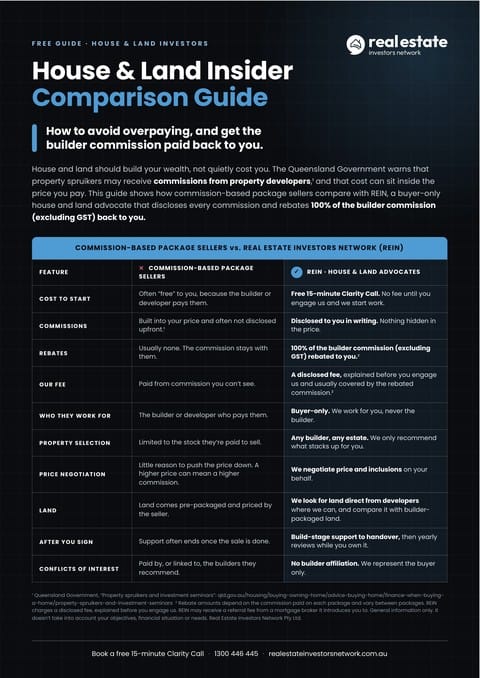
- We work for the buyer only, on new builds, never for the builder, developer or provider.
- Been shown an SDA package? We’ll check the price against standard homes nearby, the land and build split, and who’s being paid what on the sale.
- A disclosed fee, and 100% of builder commission (excluding GST) rebated to you.
- Your first Clarity Call is free. Book free call or call 1300 446 445.
Common Questions About NDIS Investment Property
Is NDIS property a good investment?
It depends almost entirely on whether the home stays occupied. SDA funding is only paid while an eligible participant lives there, apart from limited vacancy payments (NDIS Pricing Arrangements). The ACCC has warned about misleading “guaranteed income” claims. Judge the specific home, location and provider contract, not the category.
Is NDIS rental income guaranteed by the government?
No. The ACCC says claims of “government-backed” or “guaranteed income from NDIS funding” could mislead investors (ACCC). SDA funding is paid to a registered provider for a resident’s stay, capped by that resident’s plan. If nobody lives there, SDA funding generally stops.
How does SDA funding get paid to investors?
The registered SDA provider claims the funding from the NDIS after the support is delivered (NDIS Pricing Arrangements). The investor is paid under their contract with that provider, after the provider’s fees and costs. Read that contract before you buy.
How many SDA properties are there in Australia?
At 31 December 2025 there were 13,297 enrolled SDA dwellings, with 15,925 participants using SDA and 25,502 with an identified SDA need, according to the NDIA’s SDA Report 2026. Queensland had 2,790 enrolled dwellings.
Can I build an NDIS house and land package?
Yes, some marketers sell SDA as house and land or build-on-your-land packages. The home must be built to the SDA design standard and enrolled by a registered provider before it earns SDA funding (NDIS). Ask who carries the risk if enrolment is delayed or refused.
REIN was set up by someone who spent 10 years on the developer side and saw how specialist products get priced and sold. Are you weighing up an SDA home against a standard new house and land package? Read our other guides, then send us what you’ve been shown before you sign.
Written by Tom Ashby for REIN. Fact-checked against the sources below. Last updated 30 October 2026.
Important disclaimer: This article is general information only, compiled from publicly available sources on the internet. We believe it was accurate at the date of publication, but details change and errors can occur. It is not legal, tax, financial or credit advice and does not take your circumstances into account. Before you rely on anything here, confirm the facts directly with the NDIA, the SDA provider or the developer concerned, and speak to your accountant, solicitor or licensed adviser. Ratings, reviews and opinions quoted belong to their authors. REIN accepts no liability for decisions made on the basis of this article. To report an error, call 1300 446 445.
Sources
- NDIA: NDIS Pricing Arrangements for Specialist Disability Accommodation 2025–26 (Version 3.0), accessed 30 October 2026
- NDIA: Specialist Disability Accommodation (SDA) Report 2026, data at 31 December 2025, accessed 30 October 2026
- NDIS: SDA dwelling enrolment, accessed 30 October 2026
- ACCC: Specialist disability accommodation contracts, accessed 30 October 2026
More buying guides