Written by Tom Ashby for REIN · Updated 25 November 2026
Quick answer: A fixed price building contract fixes the builder’s price for the work as described in the contract. It does not fix the cost of anything still listed as an allowance (prime cost items and provisional sums), anything you change later through a variation, or, in some states and contract sizes, cost escalation allowed by a rise and fall clause. Before you sign a house and land package, find out how much of the build price sits in allowances and what the contract lets the builder pass on.
In this guide (8 sections)
- What “fixed price” means in a building contract
- Allowances: prime cost items and provisional sums
- Variations: changes after you sign
- Rise and fall clauses: can the price go up with costs?
- Fixed price vs cost plus contracts
- What this means for your numbers as an investor
- Questions to ask before you sign
- Common questions
What “fixed price” means in a building contract
In a fixed price (or lump sum) contract, the builder agrees to do the described work for a stated price. The NSW Government’s contracts guide says “it is best to get a fixed price for all work under a contract” (NSW Government, updated 29 April 2026).
The catch is in the word “described”. A fixed price only covers what the contract defines with certainty. Three things can still move the final amount you pay:
- Allowances: prime cost items and provisional sums.
- Variations: changes to the work after you sign.
- Cost escalation (rise and fall) clauses, where the law in your state allows them.
For an investor, each one matters twice. It changes what you pay, and it changes the yield you calculated on the original price.
Been shown a house and land package? Run the numbers in 60 seconds.
Free calculator: land and build split, yield, weekly cost and what to check before you sign.
Allowances: prime cost items and provisional sums
Consumer Affairs Victoria describes a prime cost (PC) item as a fitting “included in the contract but your client has not selected the actual item”, and a provisional sum (PS) as “a reasonable estimate of the cost of carrying out work if you cannot give a definite price when signing the contract” (Consumer Affairs Victoria, updated 9 July 2025).
Queensland’s building regulator gives everyday examples. PC items include “the supply of tiles, tap fittings or in-built kitchen appliances”. PS items include “allowances for the cost of rock removal, asbestos removal or earthworks” (QBCC owner and contractor guide, March 2021).
The important part is what happens when the real cost differs from the allowance. The QBCC’s guidance says that if the actual cost “is greater than the estimated amount, then the increase in cost is an additional cost”, and that for an unused amount “any credit for the unused amount should be issued by the contractor to the consumer” (QBCC guidance statement CLAIM-021, reviewed December 2023).
So a package with low allowances can look cheaper on paper than one with realistic allowances, and then cost more by handover.
What to check in the allowance schedule
- The total dollar value of all PC items and provisional sums, and what share of the build price that is.
- How each provisional sum was estimated. Site works allowances matter most on a block that hasn’t had a soil test.
- Whether the contract adds a builder’s margin to any amount over the allowance, and at what rate.
- Whether the PC allowances match the inclusions list you were shown, or a lower specification.
If a package price looks sharp, this schedule is usually where to start. Book a free 15-min Clarity Call →. We’ll check the price, the commission and the contract for you. How REIN is paid: a disclosed fee, and 100% of builder commission (excluding GST) rebated to you.
Variations: changes after you sign
Any change to the work after signing is a variation, and it usually changes the price. Each of the states below requires variations to be in writing, but the details differ.
- Victoria: the builder and owner “must agree in writing to the changes” before the work is done (Consumer Affairs Victoria).
- Queensland: “The contractor must not commence work on a variation before the owner agrees to the variation in writing” (QBCC).
- New South Wales: “Variations must be in writing and attached to the contract and signed by both” parties (NSW Government).
- Western Australia: the builder needs your written consent to a variation, and for variations that couldn’t have been foreseen, the builder must give written notice within 10 working days (WA Building and Energy guide, April 2026).
Some variations are owner-driven: an upgraded benchtop, an extra power point. Others come from the site, such as rock or extra retaining found after the slab design. Ask the builder for a list of the variations most often raised on similar homes in that estate.
Rise and fall clauses: can the price go up with costs?
A rise and fall (cost escalation) clause lets the builder pass on increases in labour or material costs during the build. The rules vary a lot by state.
| State | Rise and fall / cost escalation | Source |
|---|---|---|
| WA | “‘Rise and fall’ clauses are prohibited under the Act”. A builder generally can’t raise the price for higher labour and material costs, with limited exceptions such as delays of more than 45 working days caused by the owner or by circumstances that couldn’t reasonably be foreseen. | Building and Energy fact sheet; price increases guide (April 2026) |
| VIC | Builders must factor likely cost rises into the contract price. Under the current rules a cost escalation clause is only allowed where the contract price is more than $500,000 and the clause is approved by the Director of Consumer Affairs Victoria, and CAV says none has been approved yet. Laws passed in 2025 will allow these clauses on contracts of $1 million or more, adding no more than 5% to the price. The new rules start on a date to be proclaimed, no later than 1 December 2026, so check which rules apply on the day you sign. | CAV contract guide (9 July 2025); CAV news (15 September 2025); Maddocks on the start date (accessed 22 November 2026) |
| QLD | The QBCC pages we reviewed set no specific rise and fall rule. For contracts of $20,000 or more, the contract must include a price change warning covering any provisions that could cause the price to increase or decrease. Read that section closely and ask your solicitor how it applies. | QBCC owner and contractor guide (March 2021) |
| NSW | The NSW Government contract pages we reviewed set no specific rise and fall rule. For contracts over $20,000, the contract price must be on the first page, with a warning if it is not known or may change. | NSW Government guide (11 June 2026) |
Rules change. Check the version that applies on the date you sign, and have a solicitor or conveyancer review the contract before you commit.
Not ready to check a house and land package yet?
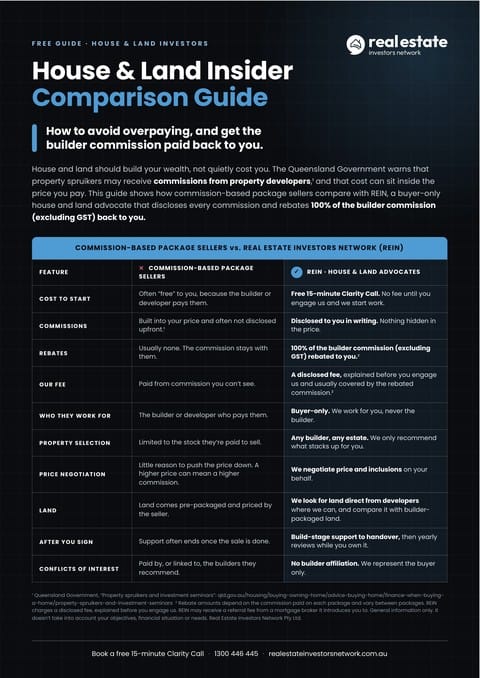
Get the House & Land Insider Comparison Guide: 14 checks to run before you sign, and how to get the builder’s commission paid back to you.
General information only. Unsubscribe any time.
Fixed price vs cost plus contracts
In a cost plus contract, you pay the builder’s actual costs plus a margin or fee, so there is no fixed total. Consumer Affairs Victoria gives an example: “when a builder charges by the hour and you do not have a fixed price for your contract” (CAV, updated 20 October 2025).
- Victoria restricts cost plus contracts: “the threshold amount above which cost plus contracts are permitted is $1 million”, with a narrow exception for investigative work on renovations (CAV).
- Queensland allows them, but the QBCC says “We do not recommend using them”, and home warranty assistance for non-completion is not available under these contracts (QBCC, reviewed 10 March 2024).
- New South Wales requires cost plus progress claims to “be supported by invoices, receipts or other documentation” (NSW Government).
House and land packages are often sold on a fixed price build contract. For an investor, that is usually the better starting point, as long as the allowances and the exclusions are realistic.
What this means for your numbers as an investor
An investor’s yield and borrowing are both set off the contract price. If the build ends up costing more because of allowances or variations, three things follow:
- Your gross yield falls, because the same rent is now divided by a higher total cost.
- You may need cash for the difference, because the loan may have been approved on the original price.
- The bank’s valuation may not rise to match your extra spend.
Here’s a simple example, using assumed figures. A $650,000 package renting at $600 a week has a gross yield of 4.8% ($600 × 52 = $31,200; $31,200 ÷ $650,000 = 4.8%). If $25,000 of allowance overruns and site variations lift the total cost to $675,000, the same rent gives about 4.6% ($31,200 ÷ $675,000 = 4.62%).
Not sure what’s in your allowance schedule? Book a free 15-min Clarity Call and bring the contract.
Questions to ask before you sign
- Is this a fixed price contract, and what exactly does the fixed price exclude?
- What is the total of the PC items and provisional sums?
- Have a soil test and contour survey been done on this lot, and is the site works figure fixed or a provisional sum?
- Does the contract include any cost escalation or price adjustment clause?
- What margin is charged on variations and on allowance overruns?
- Which variations are most common on this home design in this estate?
Our house and land contract checklist covers the rest of the contract, and our guide to split contracts vs single contracts explains how the land and build contracts fit together. If you’re weighing the price itself, read is my house and land package overpriced? and how to negotiate a house and land package.
Common questions
Can a builder increase a fixed price contract?
Yes, in limited ways. The price can change through allowance adjustments (PC items and provisional sums), written variations, and, where the law and the contract allow, cost escalation clauses. WA prohibits rise and fall clauses. Until Victoria’s new laws start (no later than 1 December 2026), it allows them only on contracts over $500,000 with regulator approval. After that, they’re allowed only on contracts of $1 million or more.
What is the difference between a prime cost item and a provisional sum?
A prime cost item is an allowance for a fitting you haven’t chosen yet, such as tapware or appliances. A provisional sum is an estimate for work that can’t be priced exactly when you sign, such as rock removal or earthworks.
Is a cost plus contract cheaper than a fixed price contract?
Not necessarily. A cost plus contract has no fixed total, so you carry the risk of cost increases. Victoria generally permits cost plus contracts only above $1 million, and the QBCC does not recommend them.
Should I get a building contract review before signing?
Yes. A solicitor or conveyancer can review the legal terms. REIN checks the price, the allowances and who is paid from the price before you sign. Book a free 15-min Clarity Call →. Still researching? Get the Insider Comparison Guide.
Sources
- Consumer Affairs Victoria: Changing a domestic building contract price (updated 9 July 2025)
- Consumer Affairs Victoria: Preparing a major domestic building contract (updated 9 July 2025)
- Consumer Affairs Victoria: Contracts (updated 20 October 2025)
- Consumer Affairs Victoria: New domestic building contract laws passed (15 September 2025)
- QBCC: Guide to domestic building contracts (March 2021)
- QBCC: Prime cost and provisional sum items guidance (reviewed December 2023)
- QBCC: Cost plus and construction management contracts (reviewed 10 March 2024)
- NSW Government: Contracts (updated 29 April 2026)
- NSW Government: Guide to providing home building contracts (updated 11 June 2026)
- WA Building and Energy: Home Building Contracts Act fact sheet
- WA: A guide to price increases in home building work contracts (April 2026)
Important disclaimer: This article is general information only, compiled from publicly available sources on the internet. We believe it was accurate at the date of publication, but details change and errors can occur. It is not legal, tax, financial or credit advice and does not take your circumstances into account. Before you rely on anything here, confirm the facts directly with your lender, your state revenue office or the government agency concerned, and speak to your accountant, solicitor or licensed adviser. Ratings, reviews and opinions quoted belong to their authors. REIN accepts no liability for decisions made on the basis of this article. To report an error, call 1300 446 445.
More buying guides