Quick answer: Victorian land tax is an annual tax on the land you own in Victoria at midnight on 31 December, charged for the following year. Since 1 January 2024 it applies once your total taxable land is worth $50,000 or more ($25,000 for trusts), so almost every investment property is caught. On $500,000 of taxable land an individual pays $1,950 a year. House and land investors also need to watch the Vacant Residential Land Tax if a new home sits empty. Real Estate Investors Network (REIN), a buyer-only house and land advocate, checks house and land packages before you sign: the land and build price, the inclusions and who is paid from the price.
In this guide (8 sections)
This is general information, not tax advice. Your accountant can tell you how land tax applies to you.
How Victorian Land Tax Works
The State Revenue Office (SRO) describes land tax as “an annual tax on the value of land you own in Victoria, excluding exempt land such as your home” (SRO). Three points decide your bill:
- When you own the land. Land tax is paid by the owner as at midnight on 31 December of the previous year. If you sell during the year, you’re still responsible for that year’s tax (SRO).
- The site value. The tax is worked out on site values set by the Valuer-General Victoria, so it’s the land, not the house, that counts (SRO).
- Who owns it. Individuals pay general rates. Land held in a trust pays trust surcharge rates from a lower threshold.
The SRO generally issues notices between January and June, and payment is due 12 weeks after the notice is issued.
Been shown a house and land package? Run the numbers in 60 seconds.
Free calculator: land and build split, yield, weekly cost and what to check before you sign.
Victorian Land Tax Rates for 2026
The SRO says its current rates apply for the 2024 to 2033 land tax years (SRO). They include the COVID Debt Repayment Plan increases, which are legislated to apply until 30 June 2033: a flat surcharge of $500 or $975, plus 0.1 percentage points on land of $300,000 or more (SRO).
General rates (individuals)
| Total taxable value | Land tax |
|---|---|
| Under $50,000 | Nil |
| $50,000 to under $100,000 | $500 |
| $100,000 to under $300,000 | $975 |
| $300,000 to under $600,000 | $1,350 plus 0.3% of the amount over $300,000 |
| $600,000 to under $1,000,000 | $2,250 plus 0.6% of the amount over $600,000 |
| $1,000,000 to under $1,800,000 | $4,650 plus 0.9% of the amount over $1,000,000 |
| $1,800,000 to under $3,000,000 | $11,850 plus 1.65% of the amount over $1,800,000 |
| $3,000,000 or more | $31,650 plus 2.65% of the amount over $3,000,000 |
Source: SRO, land tax current rates. Land held in a trust is taxed at trust surcharge rates from $25,000 (same source). Absentee owners pay a 4% surcharge on top, which doesn’t apply to Australian citizens and permanent residents living overseas (SRO).
Where the risk really sits: overpaying, and never knowing you did
Worked Examples: What an Investor Pays
These use the SRO’s general rates for one individual, with no exemptions.
| Total taxable value | Working | Land tax a year |
|---|---|---|
| $300,000 | $1,350 + (0.3% × $0) | $1,350 |
| $500,000 | $1,350 + (0.3% × $200,000) | $1,950 |
| $900,000 | $2,250 + (0.6% × $300,000) | $4,050 |
Victoria’s low threshold means even a single investment lot creates a bill, and land tax rises with every lot you add because your holdings are combined. Check your own figures with the SRO before you buy.
Land Tax on a House and Land Package
If you’re buying a house and land package in Victoria as an investment, four points apply.
- The land becomes yours for land tax at possession. The SRO treats a buyer as an owner once they’ve bought under a contract of sale and taken possession. The seller stays an owner until the buyer has taken possession and paid at least 15% of the price (SRO). If you settle on the land before 31 December, it counts for the following year even if the house is only half built.
- The construction exemption isn’t for investors. The exemption for land with a home being built requires a qualifying person to plan to live there, and no income to be earned from the land (SRO).
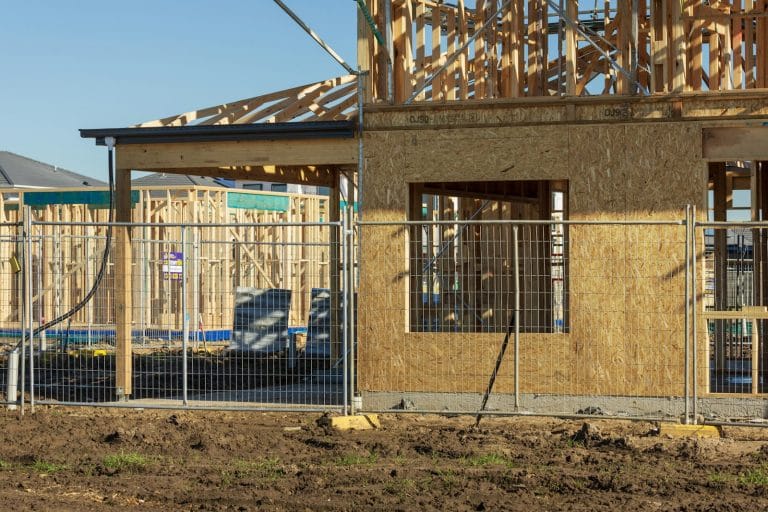
- A slow build can trigger Vacant Residential Land Tax. The SRO treats a property as vacant if, on 31 December, the home has been under construction for two years or more, counted from when the building permit was issued. Vacant Residential Land Tax is 1% of the capital improved value in the first year, rising to 2% and then 3% in later consecutive years (SRO; SRO rates).
- An empty new home can be caught too. A home not lived in for more than six months of the year can be treated as vacant, and the SRO says it isn’t enough for the property to be listed for rent (SRO). The SRO lists an exemption for a new home in the year after construction is completed (SRO), so check the timing with your accountant.
The ATO also says land tax is a cost of holding vacant land. Holding costs incurred on or after 1 July 2019 can’t be claimed until the home can lawfully be occupied and is rented or available for rent (ATO). Put land tax into your holding costs for the build period. Our investment property cash flow guide shows how.
Weighing up a Victorian package? Book a free 15-min Clarity Call →.
Paying Land Tax and Claiming It
You can pay in full, or spread the bill through the SRO’s AutoPay instalments over up to 38 weeks. No interest applies if you set up the plan before the due date (SRO).
Once the property is rented, the ATO says you can claim a deduction for land tax (ATO).
Not ready to check a house and land package yet?
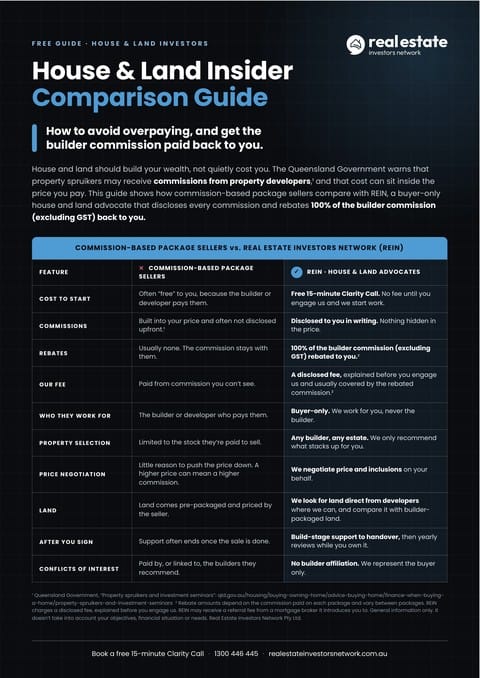
Get the House & Land Insider Comparison Guide: 14 checks to run before you sign, and how to get the builder’s commission paid back to you.
General information only. Unsubscribe any time.
Can You Reduce Victorian Land Tax?
The legitimate options mostly come down to planning before you buy:
- Count it in from day one. With a $50,000 threshold, assume every investment lot creates a bill.
- Get the build timing right. Ask the builder for a realistic start and finish date, because a build that runs past two years from the permit can bring Vacant Residential Land Tax.
- Have a tenant lined up. A new home that sits empty for long periods can be treated as vacant.
- Think about ownership before you sign. Trusts pay surcharge rates from a lower threshold. The right structure depends on your tax position, so speak to your accountant before you choose whose name goes on the contract.
How REIN Can Help
REIN works only for the buyer. Before you commit to a Victorian package, we’ll look at:
- The price. We compare the land and build price with recent sales of similar property nearby.
- The holding costs. We map out what you’ll pay between land settlement and handover, including land tax.
- The commission. We ask in writing who is being paid from the price and how much, so you know before you sign.
How we’re paid: a disclosed fee, and 100% of builder commission (excluding GST) rebated to you.
Common Questions About Land Tax in Victoria
What is the land tax threshold in Victoria?
$50,000 for individuals and $25,000 for trusts, based on the total taxable value of your Victorian land.
How much is land tax in Victoria?
For an individual with $500,000 of taxable land it’s $1,950 a year. At $900,000 it’s $4,050.
When do you pay land tax in Victoria?
It’s based on the land you own at midnight on 31 December. Notices generally go out between January and June, and payment is due 12 weeks after the notice.
Do I pay land tax while my house and land package is being built?
You can. Once you’ve taken possession of the land, it counts at 31 December even if the house isn’t finished. The construction exemption only applies if a qualifying person plans to live there.
What is Vacant Residential Land Tax?
A separate tax on residential land that’s vacant for more than six months of a year, or that has had a home under construction for two years or more. It starts at 1% of the capital improved value.
Written by Tom Ashby for REIN. Last updated 25 November 2026.
Important disclaimer: This article is general information only, compiled from publicly available sources. We believe it was accurate at the date of publication, but rates and rules change and errors can occur. It is not tax, financial or legal advice and does not take your circumstances into account. The worked examples are for illustration only. Before you rely on anything here, speak to your accountant or contact the State Revenue Office. REIN accepts no liability for decisions made on the basis of this article. To report an error, call 1300 446 445.
Image: Philip Mallis, CC BY-SA 4.0, via Wikimedia Commons.
Sources
- SRO: Understanding land tax, accessed 25 November 2026
- SRO: Land tax current rates, accessed 25 November 2026
- SRO: COVID Debt Repayment Plan, accessed 25 November 2026
- SRO: Absentee owner surcharge, accessed 25 November 2026
- SRO: Changes in ownership, accessed 25 November 2026
- SRO: Exemption for construction or renovation of a principal place of residence, accessed 25 November 2026
- SRO: Understanding vacant residential land tax, accessed 25 November 2026
- SRO: Vacant residential land tax rates, accessed 25 November 2026
- SRO: Vacant residential land tax exemptions, accessed 25 November 2026
- SRO: Pay your land tax assessment, accessed 25 November 2026
- ATO: Deductions for vacant land, accessed 25 November 2026
- ATO: Common property expenses, accessed 25 November 2026
More buying guides