Quick answer: An investment property’s cash flow is the rent you actually receive, minus the loan interest and running costs. Work it out before tax first, then after tax, and then again with a higher interest rate and a few weeks without a tenant. In the worked example below, a $650,000 house and land package costs about $208 a week before tax and about $92 a week after tax, rising to about $296 a week after tax with rates 3 percentage points higher. Real Estate Investors Network (REIN), a buyer-only house and land advocate, checks house and land packages before you sign: the land and build price, the inclusions and who is paid from the price.
In this guide (7 sections)
Been shown a house and land package? Run the numbers in 60 seconds.
Free calculator: land and build split, yield, weekly cost and what to check before you sign.
Most property brochures show the rent and the price. Cash flow is the number that decides whether you can comfortably hold the property, so it’s worth working out yourself, with your own numbers, before you sign anything.
Every fact below links to its source. The worked example uses round figures chosen to show the method. They are not a forecast.
Step 1: Work Out Cash Flow Before Tax
Cash flow before tax = rent received − loan interest − running costs.
- Rent received: use a written rental appraisal and allow for weeks without a tenant. Use the rental yield calculator to compare the rent with the price.
- Loan interest: your loan amount times your interest rate (for an interest-only loan).
- Running costs: Moneysmart lists the ongoing costs of owning an investment property, including council and water rates, insurance, body corporate fees, land tax, property management fees and repairs (Moneysmart).
Step 2: Work Out Cash Flow After Tax
If the property makes a loss, that loss can reduce the tax on your other income, within the rules. Depreciation counts as a deduction but isn’t money you spend each week, so it lowers your tax without lowering your cash. The negative gearing calculator uses the ATO’s 2026–27 resident tax rates plus the 2% Medicare levy (ATO).
From 1 July 2027, negative gearing on residential property is limited to new builds, and property held at 7:30pm AEST on 12 May 2026 is exempt. The ATO says these measures are now law (ATO). The Budget explainer said this includes property under a contract signed but not yet settled by then (Budget 2026–27 tax explainer). Here’s what the negative gearing changes mean for new builds.
Where the risk really sits: overpaying, and never knowing you did
The Worked Example
These figures are assumptions for illustration only:
- Package price: $650,000; loan $520,000 (80%), interest only at 6.5%
- Rent: $600 a week, rented for 50 weeks of the year
- Running costs: $7,000 a year
- Depreciation: $8,000 a year
- Your taxable income before the property: $120,000
| Item | Today’s rate (6.5%) | Rate 3 points higher (9.5%) |
|---|---|---|
| Rent received | $30,000 | $30,000 |
| Loan interest | $33,800 | $49,400 |
| Running costs | $7,000 | $7,000 |
| Cash flow before tax | −$10,800 a year (about −$208 a week) | −$26,400 a year (about −$508 a week) |
| Estimated tax saving (2026–27 rates, with depreciation) | $6,016 | $11,008 |
| Cash flow after tax | −$4,784 a year (about −$92 a week) | −$15,392 a year (about −$296 a week) |
The tax saving is the difference between tax (including the 2% Medicare levy) on $120,000 and tax on $120,000 less the property’s loss after depreciation. It ignores offsets and your own deductions, so speak to your accountant about your situation.
Step 3: Stress-Test It
APRA expects banks to test new borrowers at an interest rate at least 3 percentage points above their loan rate (APRA, October 2021; APRA, 28 May 2026), and the Reserve Bank’s cash rate target is 4.85% (RBA). In the example, a 3-point rise takes the after-tax cost from about $92 to about $296 a week. Here’s how to stress-test a house and land investment, step by step.
Want your numbers checked on a real package? Book a Free 15-Minute Clarity Call →.
Not ready to check a house and land package yet?
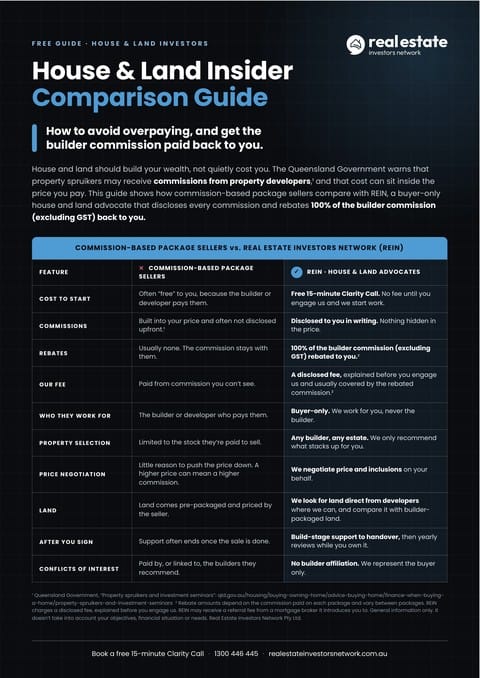
Get the House & Land Insider Comparison Guide: 14 checks to run before you sign, and how to get the builder’s commission paid back to you.
General information only. Unsubscribe any time.
Due Diligence Checklist: What to Check Before You Rely on the Numbers
- Is the rent backed by a written appraisal? Compare it with recent rents for the same size home in the suburb.
- How many weeks without a tenant have you allowed? New estates can have many homes finishing at once. Here’s how to spot an oversupplied suburb.
- Have you included every running cost? Here’s what a house and land investment really costs to hold.
- Is the price in line with recent sales? Here are six checks to see if a package is overpriced.
- Could you hold it at a rate 3 points higher? If not, the property may be too big a stretch for now.
- Who is paid from the price? If anyone introduced you to the package, ask in writing whether they’re paid a commission, by whom, and how much.
How REIN Can Help
REIN acts only for the buyer. Before you sign, we’ll check the package for you:
- Is the price competitive? We compare the land and build price with what similar property is selling for in the area.
- Do the numbers hold up? We check the rent estimate against the market and run the cash flow at higher rates and with vacancy.
- Is there a commission in the price? We ask in writing who’s being paid and how much, so you know before you sign.
How we’re paid: a disclosed fee, and 100% of builder commission (excluding GST) rebated to you.
Common Questions About Property Investment Cash Flow
What is positive and negative cash flow?
A property is cash flow positive when the rent covers the interest and running costs, and cash flow negative when you have to top it up from your own pocket. Work out both before tax and after tax.
Does depreciation improve cash flow?
Only through tax. Depreciation is a deduction, not money you spend, so it can lower your tax bill while the weekly cash cost stays the same before tax.
How much vacancy should I allow for?
There’s no fixed rule. Allowing at least a few weeks a year is a sensible test, and more if many homes nearby are finishing at the same time.
Can REIN check the cash flow on a package for me?
Yes. Book a free 15-Minute Clarity Call and we’ll check the price, the rent estimate, the cash flow and any commission built into the package.
Written by Tom Ashby for REIN. Fact-checked against the sources below. Last updated 22 November 2026.
Important disclaimer: This article is general information only, compiled from publicly available sources. We believe it was accurate at the date of publication, but details change and errors can occur. The worked example uses assumed figures for illustration only and is not a forecast. It is not legal, tax, financial or credit advice and does not take your circumstances into account. Before you rely on anything here, speak to your accountant, solicitor or licensed adviser. REIN accepts no liability for decisions made on the basis of this article. To report an error, call 1300 446 445.
Sources
- Moneysmart: Buying an investment property, accessed 22 November 2026
- ATO: Tax rates, Australian residents (2026–27), accessed 22 November 2026
- ATO: Reforming negative gearing and capital gains tax (updated 29 June 2026), accessed 24 November 2026
- Budget 2026–27: Tax explainer, negative gearing and capital gains tax, accessed 22 November 2026
- APRA: Macroprudential policy settings, 28 May 2026, accessed 20 November 2026
- Reserve Bank of Australia: Cash rate target, accessed 20 November 2026
More buying guides