Quick answer: On a rental property you can claim most running costs straight away, including loan interest, council rates, land tax, insurance, agent fees and repairs. Some costs are claimed over time, such as borrowing costs (over five years), the building itself (2.5% a year for 40 years) and fixtures and fittings. Stamp duty on the purchase isn’t deductible. From 1 July 2027, losses on established homes bought after 7:30pm AEST on 12 May 2026 can no longer be offset against your wages, while qualifying new builds can still be negatively geared. Real Estate Investors Network (REIN), a buyer-only house and land advocate, checks house and land packages before you sign: the land and build price, the inclusions and who is paid from the price.
In this guide (8 sections)
This is general information, not tax advice. Your accountant can tell you what you can claim.
What You Can Claim Straight Away
The ATO lists the expenses you can claim in the year you pay them while the property is rented or genuinely available for rent. They include (ATO):
- interest on the loan used to buy the property
- council rates, water charges and land tax
- building, contents, public liability and loss of rent insurance
- property agent’s fees and commission, and advertising for tenants
- repairs and maintenance, pest control, cleaning and gardening
- legal expenses (other than those for buying or selling)
Depreciating assets costing $300 or less can also be claimed straight away (ATO). If part of a loan was used for something private, only the investment portion of the interest is deductible (ATO).
Been shown a house and land package? Run the numbers in 60 seconds.
Free calculator: land and build split, yield, weekly cost and what to check before you sign.
What You Claim Over Several Years
- Borrowing expenses. These include lenders mortgage insurance (LMI), loan establishment fees, broker fees and valuation fees. If they total more than $100, you claim them over five years or the term of the loan, whichever is shorter. If they’re $100 or less, you claim them in the year you pay them (ATO).
- Capital works. For homes where construction started after 15 September 1987, you can claim 2.5% of the construction cost each year for 40 years. It’s based on the build cost, not the price you paid for the house and land, and you can only start once construction is complete (ATO).
- Fixtures and fittings. Items such as ovens, dishwashers and carpets that cost more than $300 are claimed as they decline in value. A quantity surveyor can prepare a depreciation schedule (ATO).
Where the risk really sits: overpaying, and never knowing you did
What You Can’t Claim
- Stamp duty on the purchase. The ATO treats it as a capital expense. It can form part of your cost base for capital gains tax (CGT) when you sell (ATO). Duty on registering the mortgage is different: it’s a borrowing expense.
- Buying and selling costs, such as conveyancing on the purchase (ATO).
- Travel to inspect a residential rental. Since 1 July 2017 most individual investors can’t claim it (ATO).
- Second-hand fixtures and fittings in a residential rental, for most individuals. There’s an exception for new homes: no one was previously entitled to a deduction for the assets, and either no one lived in the home or you bought it within six months of it being newly built (ATO). This is one reason new builds suit investors who want depreciation.
- Repairs to defects that existed when you bought. The ATO calls these initial repairs. They can’t be claimed as an immediate deduction (ATO).
The Build Period: What You Can and Can’t Claim
Since 1 July 2019, you can’t claim the costs of holding vacant land, such as interest on the land loan, land tax and council rates (ATO).
The land stops being vacant once the home can lawfully be occupied and is rented or available for rent. Until then:
- Interest on the land loan isn’t deductible.
- Interest on a separate construction loan can be. The ATO says holding costs don’t include interest on borrowings for construction. Its own example has an investor claiming the construction loan interest but not the interest on the loan used to buy the land.
- Advertising for tenants during the build is deductible.
- Costs that span the handover are split. The ATO’s example apportions council rates by the part of the year the home was available for rent.
Holding costs you can’t claim may be added to your CGT cost base (ATO). How your loans are set up matters here, so talk to your broker and accountant before settlement.
Checking a package now? Book a free 15-min Clarity Call →.
What Changes From 1 July 2027
The negative gearing and CGT changes announced in the 2026-27 Budget have been legislated. The ATO says “These measures are now law” (ATO).
- Negative gearing is limited to new builds. From 1 July 2027, losses on an established residential property can’t be deducted against other income such as wages. Treasury says the excess can be carried forward to future years (Treasury).
- Properties held at announcement are exempt. The exemption covers properties held at 7:30pm AEST on 12 May 2026 (ATO).
- New builds keep negative gearing. Treasury says new builds can continue to be negatively geared before and after 1 July 2027.
- The CGT discount changes. For gains accruing after 1 July 2027, the 50% discount is replaced by cost base indexation and a 30% minimum tax rate on capital gains (ATO). Treasury says investors in new builds can choose the existing 50% discount or the new arrangements.
Exactly what counts as a “new build” is still being settled. Treasury released a draft definition in August 2026 (Treasury), a Bill to legislate it was introduced in October 2026 (Treasury) and was before the Senate on 25 November 2026 (Parliament of Australia), and the ATO expects its draft rulings in late 2026 to early 2027 (ATO). Our negative gearing changes guide tracks the details.
Not ready to check a house and land package yet?
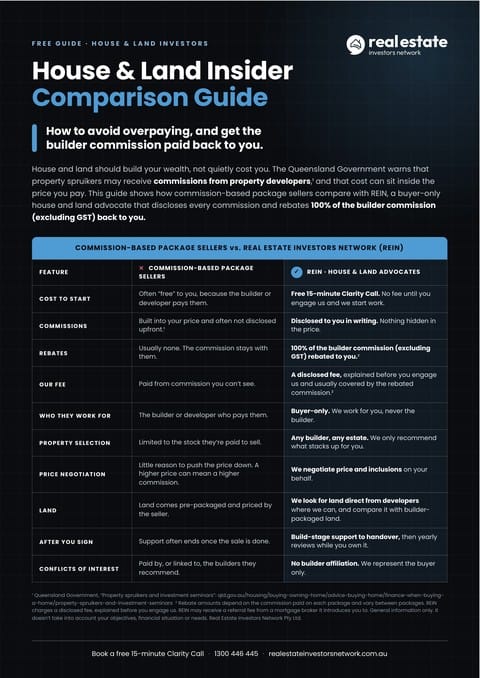
Get the House & Land Insider Comparison Guide: 14 checks to run before you sign, and how to get the builder’s commission paid back to you.
General information only. Unsubscribe any time.
Worked Example: A New House and Land Rental
The figures below are assumptions for illustration only. They show the first full year after handover, with the home rented all year.
| Item | Amount | How it’s claimed |
|---|---|---|
| Rent ($650 a week) | $33,800 | Income |
| Interest ($660,000 interest-only at an assumed 7.2%) | $47,520 | Straight away |
| Council rates and water charges | $3,100 | Straight away |
| Landlord insurance | $1,800 | Straight away |
| Agent fees (7% of rent) | $2,366 | Straight away |
| Repairs | $400 | Straight away |
| Borrowing costs ($12,600 over five years) | $2,520 | Over time |
| Capital works ($400,000 build cost × 2.5%) | $10,000 | Over time |
| Fixtures and fittings (from a depreciation schedule) | $3,000 | Over time |
| Total deductions | $70,706 | |
| Net rental loss | $36,906 |
About $15,500 of that loss comes from capital works, depreciation and borrowing costs written off over time, which cost you nothing in cash that year. Most of the fixtures and fittings claim isn’t available on an established home, because most individuals can’t claim second-hand assets in a residential rental. Land tax isn’t included because it depends on your state and your other land. A deduction only reduces your tax at your marginal rate, so a loss is still a loss. Our cash flow guide shows the after-tax position.
How REIN Can Help
Tax deductions don’t fix a bad purchase. REIN works only for the buyer, and before you sign we’ll look at:
- The price. We compare the land and build price with recent sales of similar property nearby.
- The rent. We test the rent estimate against what comparable homes in the area are renting for.
- The commission. We ask in writing who is being paid from the price and how much, so you know before you sign.
How we’re paid: a disclosed fee, and 100% of builder commission (excluding GST) rebated to you.
Common Questions About Investment Property Tax Deductions
Is stamp duty tax deductible on an investment property?
No. Stamp duty on the purchase is a capital cost. It can form part of your cost base when you sell. Duty on the mortgage is treated as a borrowing expense.
Is LMI tax deductible on an investment property?
Yes. LMI is a borrowing expense, claimed over five years or the loan term if that’s shorter.
Can I claim interest while my house and land package is being built?
Interest on the loan for the land generally isn’t deductible until the home can be occupied and is available for rent. Interest on a separate construction loan can be. Check the setup with your accountant before settlement.
Can I still negatively gear a property after 1 July 2027?
Yes, if it’s a qualifying new build or you held it at 7:30pm AEST on 12 May 2026. Losses on established homes bought after that time can’t be offset against your wages from 1 July 2027, but can be carried forward.
What is tax deductible on an investment property?
Running costs such as interest, rates, land tax, insurance, agent fees and repairs are claimed straight away. Borrowing costs, the building and fixtures are claimed over time. Purchase costs such as stamp duty aren’t deductible.
Written by Tom Ashby for REIN. Last updated 25 November 2026.
Important disclaimer: This article is general information only, compiled from publicly available sources. We believe it was accurate at the date of publication, but tax rules change and errors can occur. It is not tax, financial or legal advice and does not take your circumstances into account. The worked example uses assumed figures for illustration only. Before you rely on anything here, speak to a registered tax agent or your accountant. REIN accepts no liability for decisions made on the basis of this article. To report an error, call 1300 446 445.
Image: Kgbo, CC BY-SA 4.0, via Wikimedia Commons.
Sources
- ATO: How to claim rental expenses, accessed 25 November 2026
- ATO: Common property expenses, accessed 25 November 2026
- ATO: Borrowing expenses, accessed 25 November 2026
- ATO: Capital works deductions, accessed 25 November 2026
- ATO: Depreciating assets in rental properties, accessed 25 November 2026
- ATO: Deductions for vacant land, accessed 25 November 2026
- ATO: Rental properties and travel expenses, accessed 25 November 2026
- ATO: Interest expenses, accessed 25 November 2026
- ATO: Tax reform, negative gearing and CGT, accessed 25 November 2026
- Treasury: Budget 2026-27 tax changes, accessed 25 November 2026
- ATO: Advice under development, 2026 Budget issues, accessed 25 November 2026
More buying guides