Quick answer: From 1 July 2027, the 50% capital gains tax (CGT) discount for individuals, trusts and partnerships is replaced by indexation of your cost base for inflation, plus a 30% minimum tax on real gains. Gains built up before 1 July 2027 keep the 50% discount. Investors in new builds can choose the 50% discount or the new method when they sell. The core changes are law under the Tax Reform No. 1 Act 2026. Real Estate Investors Network (REIN), a buyer-only house and land advocate, checks house and land packages before you sign: the land and build price, the inclusions and who is paid from the price.
In this guide (10 sections)
- What Changed in the 2026 Budget
- When the CGT Changes Start
- What Happens to Property You Already Own
- New Builds Get a Choice
- Who Is Exempt or Treated Differently
- Is It Law Yet?
- What It Means for House and Land Investors
- How REIN Can Help With the 2026 Tax Changes
- Common Questions About the Capital Gains Tax Changes
- More house and land investment guides
Been shown a house and land package? Run the numbers in 60 seconds.
Free calculator: land and build split, yield, weekly cost and what to check before you sign.
Read this before you sign
New builds keep a choice on CGT and keep negative gearing. Established homes bought now don’t. That makes the “new build” label worth money to sellers, so check you aren’t paying for it twice.
Get My Package Checked → or call 1300 446 445
The 2026 Budget made the biggest change to how property investors are taxed on sale in more than 25 years. If you are buying now, the rules decide what you keep when you sell.
This guide covers what changed, who is exempt, what happens to property you already own and what it means if you are buying a house and land package. Every fact below links to its source.
This is general information, not tax or financial advice. Speak to your accountant about your own situation.
What Changed in the 2026 Budget
The changes were announced on Budget night, 12 May 2026, alongside the negative gearing changes (Budget 2026–27 tax explainer):
- The 50% discount ends for individuals, trusts and partnerships from 1 July 2027.
- Indexation returns. For assets held at least 12 months, your cost base is increased for inflation (CPI), similar to the system used from 1985 to 1999.
- A 30% minimum tax applies to real (after-inflation) capital gains.
- New builds get a choice between the 50% discount and indexation plus the minimum tax.
Treasury lists the measures on its Budget 2026–27 tax changes page.
When the CGT Changes Start
The new rules apply to gains from 1 July 2027, the 2027–28 income year (Budget 2026–27 tax explainer; Treasurer’s second reading speech).
Some early reports gave conflicting start dates. The official material is consistent: 12 May 2026 is the cutoff for negative gearing grandfathering, and both measures operate from 1 July 2027.
What Happens to Property You Already Own
Gains that built up before 1 July 2027 keep the 50% discount. To work out that portion, you can get a valuation as at 1 July 2027 or use an apportionment formula. The ATO will provide tools (Budget 2026–27 tax explainer).
If you own an investment property now, a valuation around 1 July 2027 may matter. Ask your accountant whether one makes sense for you.
New Builds Get a Choice
When you sell a new build, you can choose either the 50% discount or indexation plus the minimum tax, whichever suits you (Budget 2026–27 tax explainer; second reading speech). New builds also keep full negative gearing. We cover that in Negative Gearing Changes 2026.
What counts as “new” matters. The Budget defines it as a dwelling that adds to housing supply. A like-for-like knock-down rebuild or a renovation doesn’t count (Budget 2026–27 tax explainer). The final definition sits in the Tax Reform No. 3 Bill 2026, introduced on 14 October 2026 (second reading speech).
Who Is Exempt or Treated Differently
- Your home: the main residence exemption is unchanged (second reading speech).
- People on income support: the minimum tax doesn’t apply to people receiving means-tested income support, such as the Age Pension or JobSeeker, in the year of sale (second reading speech).
- Affordable housing: the discount of up to 60% for affordable housing is retained (second reading speech).
- Small business: the small business concession threshold was lifted from $2 million to $10 million turnover before the bill passed (ABC News).
- Pre-1985 assets: these lose their exemption for gains made after July 2027 (second reading speech).
Is It Law Yet?
Yes, the core changes are. The Treasury Laws Amendment (Tax Reform No. 1) Act 2026 is Act No. 49 of 2026, dated 26 June 2026 (Federal Register of Legislation). It passed with Greens support (ABC News).
A second bill, the Tax Reform No. 3 Bill 2026, covers the new dwelling definition and CGT in complex cases. It went to consultation in August 2026 (Treasury consultation) and was introduced on 14 October 2026 (second reading speech). Treat those details as not final until it passes.
Already been shown a house and land package? Get My Package Checked before you sign.
What It Means for House and Land Investors
Where it helps
A house and land package built on vacant land is the kind of dwelling the rules aim to reward. You keep negative gearing and you keep a choice on CGT when you sell.
Where the risk sits
- Paying a premium for the label. Sellers know new builds now carry a tax advantage. Compare the land and build price against recent sales, not against other packages.
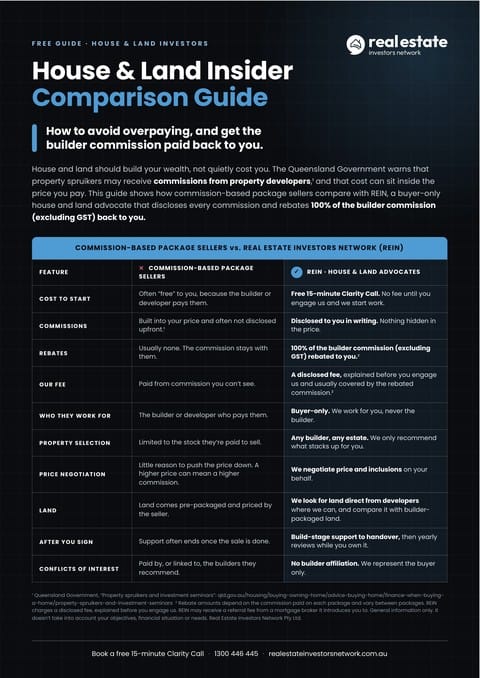
- Commissions hidden in the price. Package marketers are often paid by the builder or developer. Ask who is being paid, and how much.
- Assuming it qualifies. Check the contract structure against the final new dwelling definition with your accountant before you rely on the tax treatment.
Where the risk sits
The tax rules now favour new builds. That doesn’t make every new build a good buy. We’ll show you where the price, the commission and the contract leave you exposed.
How REIN Can Help With the 2026 Tax Changes
REIN acts only for the buyer. Before you sign, we check the package for you:
- Is the price right? We compare the land and build price against recent sales nearby.
- Is there a commission in the price? We find out who is being paid, and how much.
- Is it the kind of property the rules favour? We flag what to confirm with your accountant before you sign.
A REIN service fee applies, agreed in writing before you start, and we rebate 100% of any builder or developer commission we receive on your purchase (excluding GST). We stay with you through the build to handover.
Start with a free 15-Minute Clarity Call. Book a free 15-Minute Clarity Call or call 1300 446 445.
Why check before you sign. Not every builder pays a sales commission, and if yours doesn’t, we’ll tell you straight. But in 2018 the ABC reported property sales companies offering payments of 5 to 10 per cent or more of the property price for sales referrals on apartment and off-the-plan property (ABC News). If a commission is built into your package, we’ll show you, and 100% of it (excluding GST) is rebated to you.
Common Questions About the Capital Gains Tax Changes
Is the 50% CGT discount being removed?
For most assets, yes, from 1 July 2027. It is replaced by indexation of the cost base plus a 30% minimum tax on real gains. Gains made before 1 July 2027 keep the 50% discount, and new builds can still choose it (Budget 2026–27 tax explainer).
When do the capital gains tax changes start?
1 July 2027, the start of the 2027–28 income year (second reading speech).
Do the CGT changes affect my home?
No. The main residence exemption is unchanged (second reading speech).
What happens if I sell an investment property I bought years ago?
The gain made up to 1 July 2027 keeps the 50% discount. The gain after that falls under the new rules. You can use a valuation at 1 July 2027 or an apportionment formula to split it (Budget 2026–27 tax explainer).
Do the changes apply to shares?
The CGT discount change applies to assets generally, not only property. The negative gearing limits apply only to residential property (Budget 2026–27 tax explainer).
Before you sign anything…
Send us the package. We’ll check the price, any commission built into it and the contract terms, and tell you straight whether it stacks up.
Get My Package Checked → or call 1300 446 445
Comparing house and land packages right now? Talk to us before you sign. Start with the REIN investor guides or Book a free 15-Minute Clarity Call.
Written by Tom Ashby for REIN. Fact-checked against the sources below. Last updated 21 October 2026.
Important disclaimer: This article is general information only. It has been compiled from publicly available sources on the internet and is believed to be accurate at the date of publication, but details change and errors can occur. It is not legal, tax, financial or credit advice and does not take your circumstances into account. Before you act, confirm the facts directly with the relevant company, government agency or lender, and speak to your accountant, solicitor or licensed adviser. REIN accepts no liability for decisions made on the basis of this article. To report an error, call 1300 446 445.
Sources
- Budget 2026–27: Tax explainer – Negative gearing and CGT reform, accessed 21 October 2026
- Treasury: Budget 2026–27 tax system changes, accessed 21 October 2026
- Treasurer: Second reading speech, Tax Reform No. 1 Bill, accessed 21 October 2026
- Treasury Laws Amendment (Tax Reform No. 1) Act 2026, accessed 21 October 2026
- Treasury: Consultation on Tax Reform No. 3 exposure draft, accessed 21 October 2026
- Treasurer: Second reading speech, Tax Reform No. 3 Bill, accessed 21 October 2026
- ABC News: Greens agreement on CGT and negative gearing (23 June 2026), accessed 21 October 2026
More on tax and finance