Quick answer: From 1 July 2027, negative gearing on residential property is limited to new builds. Investors who held property before 7:30pm AEST on 12 May 2026 keep it until they sell. The 50% capital gains tax discount is replaced by indexation and a 30% minimum tax on gains, with new dwellings treated more generously. The law has passed. The exact definition of a “new build” will be set by a second bill, the Tax Reform No. 3 Bill, which is still before the Senate, so check its final form and where your purchase stands before you rely on the deduction.
In this guide (11 sections)
- What Is Negative Gearing?
- What Changed and When
- Bought an Established Property After 12 May 2026? The “Grace Period” Explained
- Who Keeps Negative Gearing
- What Counts as a “New Build”
- The Capital Gains Tax Changes
- What It Means for House and Land Investors
- Questions to Ask Before You Buy a New Build
- How REIN Can Help Before You Buy a New Build
- Common Questions About the Negative Gearing Changes
- More investor guides
Been shown a house and land package? Run the numbers in 60 seconds.
Free calculator: land and build split, yield, weekly cost and what to check before you sign.
This is general information, not tax or financial advice. Speak to your accountant about your own situation.
What Is Negative Gearing?
A rental property is negatively geared when its deductible costs, such as loan interest, rates, insurance, repairs and depreciation, are more than the rent it earns. Before these changes, that loss could reduce the tax you pay on other income, such as your wages. From 1 July 2027, investors in established properties bought after Budget night lose that option, while new builds keep it (Treasury; Budget 2026–27 tax explainer).
What Changed and When
The changes were announced in the Federal Budget on 12 May 2026. The ATO says “These measures are now law” (ATO). The Treasury Laws Amendment (Tax Reform No. 1) Act 2026 received Royal Assent on 26 June 2026 (Federal Register of Legislation).
- Negative gearing: limited to new builds for residential property, from 1 July 2027.
- Capital gains tax: the 50% discount for individuals, trusts and partnerships is replaced by cost base indexation and a 30% minimum tax rate on capital gains, from 1 July 2027.
- Existing investors: properties held at announcement are exempt from the negative gearing change, and the CGT change applies only to gains that build up after 1 July 2027 (ATO).
Bought an Established Property After 12 May 2026? The “Grace Period” Explained
You may have seen the changes described as having a one-year grace period. That phrase is not in the official material, but the effect is real. According to the Budget 2026–27 tax explainer:
- Held before 7:30pm AEST on 12 May 2026 (including contracts signed before then): you keep negative gearing until you sell.
- Established property bought after 12 May 2026 and before 1 July 2027: losses can be offset against other income only until 30 June 2027.
- Established property bought from 1 July 2027: losses can only be used against residential property income, including capital gains. Unused losses carry forward.
New builds keep full negative gearing either way (Treasury).
Who Keeps Negative Gearing
If you entered into a contract to buy a residential property before 7:30pm ACT time on 12 May 2026, you are grandfathered. The Act treats your ownership as starting when you enter into the contract, not at settlement (Tax Reform No. 1 Act, s 26-155). The Treasurer said grandfathered properties will be “allowed to be negatively geared in future years until sold” (Second reading speech).
If you buy an established property after that time, rental losses from the 2027–28 income year are no longer deductible against your wages or other income. They become a “quarantined amount” that can be used against net capital gains, with any balance carried forward against future residential rental income (Tax Reform No. 1 Act, s 26-155). The deduction is delayed, not lost, but your cash flow while you hold the property is worse.
What Counts as a “New Build”
This is the part that matters most for house and land buyers. The Act itself does not define a new build. It leaves the test to a legislative instrument made by the Minister, which must cover dwellings that genuinely add to housing supply (Tax Reform No. 1 Act, s 26-160). Treasury released a draft definition for consultation in August 2026, and the Government said the final definition will be put into primary legislation (Treasury consultation). Until that law passes, the draft is the best guide, not the law.
Under the exposure draft (Treasury explanatory material):
- A dwelling is new if its certificate of occupancy was first issued after the announcement time. Buying land and building a house on it would generally fit this test.
- An off-the-plan apartment is treated as a new residential dwelling.
- A renovation does not make an existing dwelling new, even if a new certificate of occupancy is issued.
- A knockdown-rebuild of a derelict building can qualify.
- A later buyer can still treat the dwelling as new if they acquire it within 24 months of the certificate of occupancy first being issued, even if someone has lived in it.
For house and land buyers, the key document is the certificate of occupancy (or your state’s equivalent). Its date, not the date on your land contract, is what the draft looks at.
Update, November 2026: the August 2026 exposure draft proposed extending the window to buy a new dwelling to 24 months after the certificate of occupancy, up from 12 months in the Budget (Treasurer media release, 4 August 2026). The final definition sits in the Treasury Laws Amendment (Tax Reform No. 3) Bill 2026, introduced on 14 October 2026 (second reading speech). As at 10 November 2026 it had passed the House of Representatives (29 October 2026) and was before the Senate, with a Senate committee due to report on 13 November 2026 (Parliament of Australia). Check the final law before you rely on it.
The Capital Gains Tax Changes
From 1 July 2027, individuals, trusts and partnerships get cost base indexation instead of the 50% discount, generally on assets held for at least 12 months. A new 30% minimum tax applies to capital gains. New builds and affordable housing can still use the 50% discount, and gains taxed that way are excluded from the 30% minimum tax. The owner can choose indexation instead, but the minimum tax then applies (Tax Reform No. 1 Act, ss 115-102 and 119-5).
For assets you already hold, gains up to 1 July 2027 keep the 50% discount. The asset is treated as sold and bought back at market value on that date, with the tax deferred until you actually sell (Tax Reform No. 1 Act, ss 112-155 to 112-185). Get a valuation on file before 1 July 2027, or ask your accountant about the alternative apportioning method.
What It Means for House and Land Investors
The tax system now favours new homes over established ones. That helps house and land investors in three ways, and creates one big risk.
Where it helps
- Negative gearing stays available on a new build, so losses can still reduce tax on your other income.
- Better CGT treatment on new dwellings than on established property bought after the changes.
- Depreciation on a new home is usually higher than on an older one, as our investment property depreciation guide explains.
Where the risk sits
When a tax benefit applies only to one kind of property, sellers of that property try to capture it in the price. Investor demand has already shifted: Cotality links weaker investor demand in 2026 to the negative gearing and capital gains tax changes (Cotality). Expect more marketing that leads with the tax benefit, and watch the package price. A tax deduction does not turn an overpriced property into a good investment. If the package carries a hidden commission, you may pay for it on day one and only recover it through future growth.
Also remember the land period. Holding costs on vacant land, such as interest on the land loan, rates and land tax, are generally not deductible until the dwelling can be lawfully occupied and is leased or available for lease. The ATO says the cost of building the home, and interest on loans for that work, are not holding costs (ATO). Ask your accountant how this applies to your loan structure.
Questions to Ask Before You Buy a New Build
- When will the certificate of occupancy be issued, and what happens to my tax position if the build runs late?
- If I am buying a recently completed home, when was the certificate of occupancy first issued? Is it within 24 months?
- What is the land and build price compared with similar established homes nearby?
- Is anyone being paid a commission on this sale, and how much?
- What will the property rent for, and how many new homes are being released nearby?
- Has my accountant modelled the after-tax cash flow, including the land period?
How REIN Can Help Before You Buy a New Build
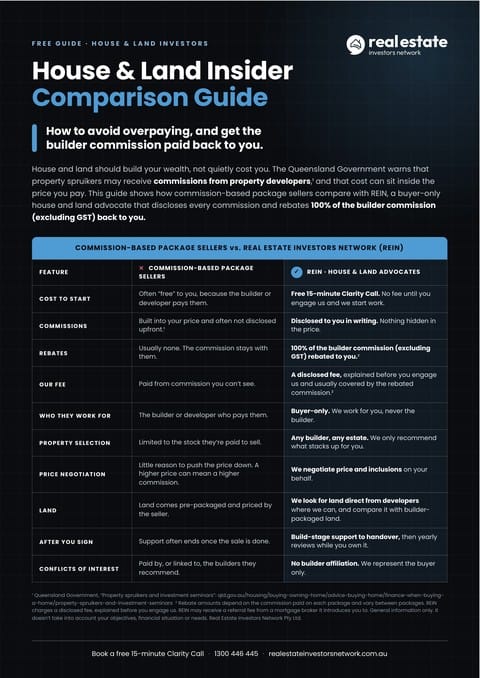
You don’t have to work all of this out on your own. REIN acts only for the buyer. Before you sign, we’ll check the package for you:
- Is the price competitive? We compare the land and build price with what similar property is selling for in the area.
- Is there a commission in the price? We find out who’s being paid and how much, so you don’t pay over the odds without knowing it.
- Where does the contract leave you exposed? We go through the provisional sums, site costs, guarantee conditions and price-rise clauses.
How REIN is paid: a disclosed fee, and 100% of builder commission (excluding GST) rebated to you.
And we don’t disappear at settlement. We’re with you through the build to handover, and for as long as you own the property, with yearly reviews of the rent, value and finance.
Why check before you sign. Not every builder pays a sales commission, and if yours doesn’t, we’ll tell you straight. If a commission is built into your package, we’ll show you. Get My Package Checked, or Book a 15-Minute Clarity Call if you would rather talk it through first.
Common Questions About the Negative Gearing Changes
Is negative gearing being abolished?
No. From 1 July 2027 it is limited to new builds for residential property. Properties held before 7:30pm AEST on 12 May 2026 keep it until they are sold.
Does a house and land package count as a new build?
Under Treasury’s exposure draft, a dwelling is new if its certificate of occupancy is first issued after the announcement, which a newly built home would generally meet. The final definition is in the Treasury Laws Amendment (Tax Reform No. 3) Bill 2026, which the Treasurer said “legislates the definition of a new residential dwelling” (second reading speech, 14 October 2026). Check whether it has passed in that form, and confirm with your accountant before you buy.
I signed a contract before 12 May 2026 but settled after. Am I grandfathered?
The Act treats your interest as starting when you enter into the contract, so a contract signed before 7:30pm ACT time on 12 May 2026 should count. Confirm the details with your accountant.
What happens to losses on an established property bought after the announcement?
From the 2027–28 income year they can’t be deducted against wages. They can be used against net capital gains, and any balance carries forward against future residential rental income.
Do new builds still get the 50% CGT discount?
Yes. Under the Act, gains on new builds can still use the 50% discount, and those gains are excluded from the 30% minimum tax. The owner can choose indexation instead, in which case the minimum tax applies.
Is there a grace period for the negative gearing changes?
Not by that name. But established property bought after 7:30pm AEST on 12 May 2026 and before 1 July 2027 can still have its losses offset against other income until 30 June 2027. From 1 July 2027, those losses can only be used against residential property income (Budget 2026–27 tax explainer).
Does this affect the property I already own?
Not if you held it, or had signed the contract, before 7:30pm AEST on 12 May 2026. You keep negative gearing on that property until you sell it (Budget 2026–27 tax explainer).
When do the changes start?
Both the negative gearing and CGT changes start on 1 July 2027.
Before you sign anything… Real Estate Investors Network (REIN), a buyer-only house and land advocate, checks house and land packages before you sign: the land and build price, the inclusions and who is paid from the price.
We’ll check the price, the commission and the contract for you. How REIN is paid: a disclosed fee, and 100% of builder commission (excluding GST) rebated to you.
GET MY PACKAGE CHECKED → or call 1300 446 445
Written by Tom Ashby for REIN. Fact-checked against the sources below. Last updated 10 November 2026.
Important disclaimer: This article is general information only, compiled from publicly available sources on the internet. We believe it was accurate at the date of publication, but details change and errors can occur. It is not legal, tax, financial or credit advice and does not take your circumstances into account. Before you rely on anything here, confirm the facts directly with the company, builder, developer or government agency concerned, and speak to your accountant, solicitor or licensed adviser. Ratings, reviews and opinions quoted belong to their authors. REIN accepts no liability for decisions made on the basis of this article. To report an error, call 1300 446 445.
Sources
- ATO: Reforming negative gearing and capital gains tax
- Treasury Laws Amendment (Tax Reform No. 1) Act 2026
- Treasury consultation: new residential dwellings instrument
- Treasury exposure draft explanatory material
- Treasurer’s second reading speech
- Treasury: Budget 2026–27 tax measures
- ATO: Deductions for vacant land
- Cotality Home Value Index, October 2026
- Budget 2026–27: Tax explainer – Negative gearing and CGT reform – accessed 21 October 2026
- Treasurer: Consultation on next tranche of tax reform legislation (4 Aug 2026) – accessed 21 October 2026
- Treasurer: Second reading speech, Tax Reform No. 3 Bill (14 Oct 2026) – accessed 21 October 2026
- Parliament of Australia: Treasury Laws Amendment (Tax Reform No. 3) Bill 2026, bill homepage – accessed 10 November 2026
More on tax and finance