Quick answer: Most lenders let you borrow up to 80% of your home’s value, minus what you still owe. That amount is your usable equity, and it can fund the deposit and costs on an investment property. Borrow beyond 80% and you may pay lenders mortgage insurance. Banks still test whether you could repay at a higher rate (APRA’s buffer is 3 percentage points), and the interest is only tax deductible if the money is used for the investment. Real Estate Investors Network (REIN), a buyer-only house and land advocate, checks house and land packages before you sign: the land and build price, the inclusions and who is paid from the price.
In this guide (10 sections)
- How Usable Equity Is Worked Out
- Step by Step: How to Use Equity to Buy an Investment Property
- How Much Could Your Equity Buy?
- What the Banks Test
- How the Tax Deduction Works
- Cross-Collateralisation: Read the Loan Structure
- Where the Risk Sits When You Use Equity for a House and Land Package
- How REIN Can Help With Your First Investment
- Common Questions About Using Equity to Buy an Investment Property
- More house and land investment guides
Been shown a house and land package? Run the numbers in 60 seconds.
Free calculator: land and build split, yield, weekly cost and what to check before you sign.
Read this before you sign
Equity gets you the deposit. It doesn’t make a package a good buy. If the price carries a builder commission, you are borrowing against your home to pay it.
Get My Package Checked → or call 1300 446 445
For many first-time investors, the deposit isn’t sitting in a savings account. It’s sitting in the home they already own.
This guide shows how usable equity is worked out, what the banks test, how the tax deduction works and where the risk sits when you use equity to buy a new house and land package. Every fact below links to its source.
This is general information, not tax or financial advice. Speak to your accountant about your own situation.
How Usable Equity Is Worked Out
Equity is your property’s value minus the loan against it (Westpac). Lenders don’t let you borrow all of it. NAB explains it this way: “lenders usually let you borrow up to 80 percent of your home’s value, less your current loan” (NAB).
| Step | NAB’s example |
|---|---|
| Home value | $400,000 |
| 80% of value | $320,000 |
| Less current loan | $220,000 |
| Usable equity | $100,000 |
Your lender may require a formal valuation, so your number depends on what the bank thinks the home is worth, not the figure you have in mind (Westpac).
Step by Step: How to Use Equity to Buy an Investment Property
- Get a valuation. Your lender values your home first, and its figure sets your equity (CommBank).
- Work out your usable equity. Take 80% of the valuation and subtract what you owe, as in the table above.
- Access it. Borrowers generally refinance their existing home loan or top it up, and the bank decides based on your income, debts and the property’s value (CommBank).
- Use it as the deposit. The equity covers the deposit, and a new loan covers the rest of the investment purchase (CommBank). Keep the equity draw as its own loan split (see the tax section below).
- Keep a reserve. Only go ahead if you could cover the repayments on both loans while the home is being built and earns no rent, and whenever it is between tenants (CommBank). ING suggests not using every last cent of your equity, so some stays as a buffer (ING).
How Much Could Your Equity Buy?
ING’s rule of thumb is that you may be able to borrow up to five times your usable equity, with the equity acting as your deposit. On $100,000 of usable equity, that is a loan of about $500,000 (ING). Your income, debts and living costs still decide what the lender will approve.
That rule treats all of the equity as deposit. Stamp duty, legal fees, inspections and lenders mortgage insurance also need paying (ING). If they come out of the same equity, the deposit shrinks and so does the price you can reach. For example, if $25,000 of a $100,000 equity release went on costs, the $75,000 left is a 20% deposit on a $375,000 purchase. With the full $100,000 as a 20% deposit, the purchase price would be $500,000.
What the Banks Test
- Serviceability buffer: Banks test whether you could still afford the loan at a higher interest rate. APRA kept this serviceability buffer at 3 percentage points on 28 May 2026 (APRA).
- Debt-to-income limit: from 1 February 2026, banks can write no more than 20% of new mortgage lending at six times income or more. The limit applies separately to investor and owner-occupier lending. Loans to buy or build new dwellings are excluded (APRA).
- Lenders mortgage insurance: LMI usually applies when you borrow more than 80% of the property value. It is usually a one-off cost and “only protects the lender” (Moneysmart).
The limit caps each bank’s overall lending, not individual borrowers, but loans for new dwellings sit outside it.
How the Tax Deduction Works
The ATO looks at what the borrowed money is used for, not what secures it. Interest on money used to buy a rental property is deductible. Interest on money used for private purposes isn’t (ATO).
- If one loan funds both private and investment spending, you must split the interest between them for the life of the loan (ATO).
- Redrawing from an investment loan for private spending reduces the deductible share (ATO).
Set the loan up as a separate split for the investment from day one. Ask your accountant and broker to confirm the structure before settlement.
From 1 July 2027, losses on established properties purchased from 7:30pm (AEST) on 12 May 2026 can only be deducted against residential property income, including capital gains. These measures are now law (ATO). A new build that adds to housing supply keeps full negative gearing, but generally only for the first buyer: a property that has already been sold usually doesn’t qualify (Budget 2026–27 tax explainer). See Negative Gearing Changes 2026.
Cross-Collateralisation: Read the Loan Structure
Some lenders secure the new loan against both your home and the investment. Westpac says this “may give you less flexibility” and “could mean more work to separate them down the track” (Westpac). If something goes wrong, both properties can be exposed.
Moneysmart also warns that if the property value falls, “you could end up owing more than the property is worth” (Moneysmart).
Where the Risk Sits When You Use Equity for a House and Land Package
- Borrowing against your home to pay a commission. If the package price includes a builder or developer commission, it is funded by your equity. Ask who is paid, and how much.
- A valuation below the price. If the bank values the new home below what you paid, the gap comes out of your pocket or your equity.
- Construction stages. Build loans are drawn in stages. Make sure your equity covers the deposit, costs and any variations before the first stage. See construction loans for house and land.
- Loan structure. Keep your home separate from the new loan unless you choose otherwise.
Check it before you commit your equity
Your equity is your safety net. Before you use it, we’ll check whether the package price stacks up and what’s built into it.
Get My Package Checked → or call 1300 446 445
How REIN Can Help With Your First Investment
REIN acts only for the buyer. Before you sign, we check the package for you:
- Is the price right? We compare the land and build price against recent sales nearby.
- Is there a commission in the price? We find out who is being paid, and how much.
- What’s in the contract? We check the land and build contracts, inclusions and build timeframe before you commit your equity.
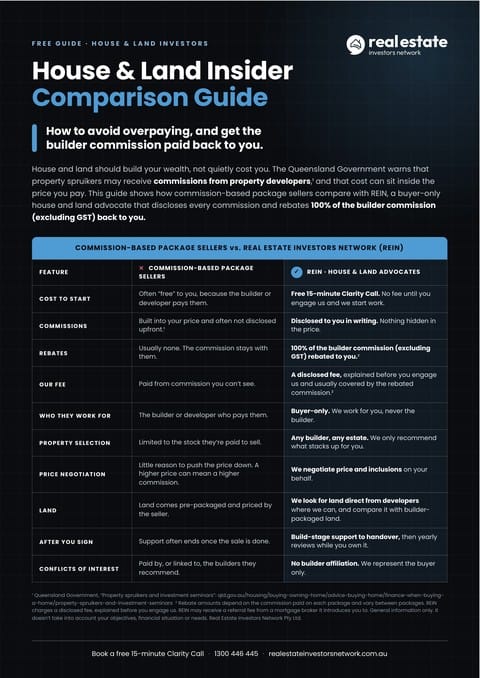
We’ll check the price, the commission and the contract for you. How REIN is paid: a disclosed fee, and 100% of builder commission (excluding GST) rebated to you. We stay with you through the build to handover.
Book a free 15-Minute Clarity Call or call 1300 446 445.
Common Questions About Using Equity to Buy an Investment Property
How much equity do I need to buy an investment property?
Enough to cover the deposit and purchase costs at the lender’s maximum loan size. If you want to avoid lenders mortgage insurance, that usually means a 20% deposit plus costs, because LMI applies above 80% of the property value (Moneysmart).
How do I calculate my usable equity?
Take 80% of your home’s value and subtract what you owe. On NAB’s example, 80% of $400,000 is $320,000, less a $220,000 loan, leaving $100,000 of usable equity (NAB).
How much can I borrow using the equity in my home?
ING’s rule of thumb is up to five times your usable equity, so $100,000 could support a loan of about $500,000 if the lender is satisfied you can afford it. Buying costs paid from the same equity reduce that figure (ING).
Is the interest on an equity loan tax deductible?
Generally yes, if the money is used to buy the investment property. The ATO looks at how the money is used, not which property secures it (ATO). Speak to your accountant about your own situation.
Should I cross-collateralise my home and investment?
It is a choice, not a requirement. Westpac notes it may give you less flexibility and can be harder to separate later (Westpac). Ask your broker about separate loans.
Do the APRA debt-to-income limits apply to new builds?
Loans to buy or build new dwellings are excluded from APRA’s debt-to-income limit, which started on 1 February 2026 (APRA).
Before you sign anything…
Send us the package. We’ll check the price, any commission built into it and the contract terms, and tell you straight whether it stacks up.
Get My Package Checked → or call 1300 446 445
Written by Tom Ashby for REIN. Fact-checked against the sources below. Last updated 11 November 2026.
Important disclaimer: This article is general information only, compiled from publicly available sources on the internet. We believe it was accurate at the date of publication, but details change and errors can occur. It is not legal, tax, financial or credit advice and does not take your circumstances into account. Before you rely on anything here, confirm the facts directly with your lender, your state revenue office or the government agency concerned, and speak to your accountant, solicitor or licensed adviser. Ratings, reviews and opinions quoted belong to their authors. REIN accepts no liability for decisions made on the basis of this article. To report an error, call 1300 446 445.
Sources
- NAB: Using equity to invest, accessed 11 November 2026
- Westpac: Using equity to invest in property, accessed 11 November 2026
- Moneysmart: Lenders mortgage insurance, accessed 11 November 2026
- Moneysmart: Buying an investment property, accessed 11 November 2026
- APRA: Limit on high debt-to-income home loans (27 Nov 2025), accessed 11 November 2026
- APRA: Macroprudential policy settings (28 May 2026), accessed 11 November 2026
- ATO: Interest expenses for rental properties, accessed 11 November 2026
- Budget 2026–27: Tax explainer – Negative gearing and CGT reform, accessed 11 November 2026
- CommBank: Using equity to buy property, accessed 11 November 2026
- ING: Using equity to buy investment property, accessed 11 November 2026
- ATO: Tax reform, negative gearing and capital gains tax, accessed 11 November 2026
More on tax and finance