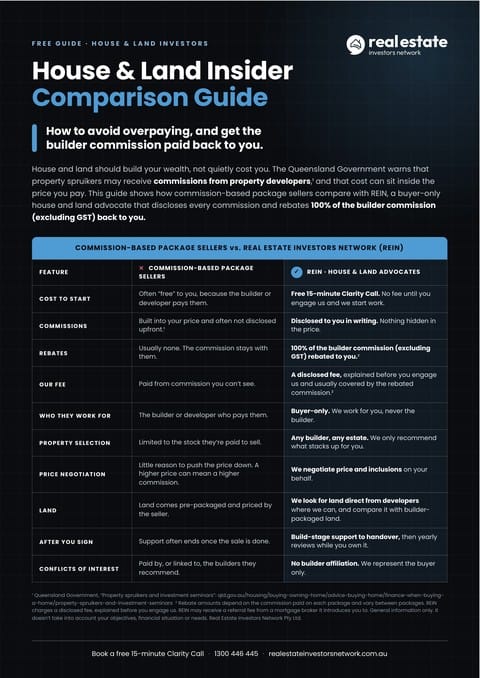
Quick answer: In Australia, anyone can call themselves a property investment advisor. Real estate isn’t a financial product, so property investment advice needs no ASIC licence or set training, as a Senate Economics Committee report found. Licences only apply to parts of the job: selling property, arranging loans, or advising on super. ASIC says recommending an SMSF to buy property needs an AFS licence. Check what they hold and how they’re paid. Real Estate Investors Network (REIN), a buyer-only house and land advocate, is paid this way: a disclosed fee, and 100% of builder commission (excluding GST) rebated to you.
In this guide (8 sections)
- What a Property Investment Advisor Does
- Do Property Investment Advisors Need a Licence?
- Industry Credentials Worth Checking
- How Property Investment Advisors Get Paid
- Property Investment Advisor vs Financial Planner vs Buyers Agent
- Questions to Ask a Property Investment Advisor
- How REIN Can Help
- Common Questions About Property Investment Advisors
Been shown a house and land package? Run the numbers in 60 seconds.
Free calculator: land and build split, yield, weekly cost and what to check before you sign.
Read this before you sign
- “Property investment advisor” is a job title, not a licence. Ask which licence covers each thing they’ll do for you.
- Ask in writing whether a developer, builder or anyone else pays them if you buy what they recommend.
- If they suggest using your super, ask to see their AFS licence or authorisation.
Most people hire a property investment advisor because they don’t want to make a six-figure mistake on their own. That’s sensible. The catch is that the title covers everyone from a qualified, buyer-paid strategist to a salesperson working through a list of projects that pay them commission.
This guide covers what a property investment advisor does, which parts of the job need a licence, the industry credentials worth checking, how advisors get paid, and the questions that tell you which kind you’re talking to. Every fact below links to its source.
What a Property Investment Advisor Does
There’s no set job description. People using the title usually do one or more of these:
- Strategy: how much to borrow, what type of property, which market, and how the purchase fits a longer plan.
- Finding and buying: searching, assessing and negotiating on your behalf, like a buyers agent.
- Supplying stock: recommending properties from a list of projects, often new builds, house and land or apartments.
- Finance and structure: arranging loans, or advising on whether to buy in your name, a trust or your super.
The first is the advice you think you’re getting. The third is where conflicts usually sit. Many advisors do all four, which is why the questions further down matter more than the title on the business card.
Do Property Investment Advisors Need a Licence?
For general property advice, no. Real estate isn’t a financial product under the Corporations Act, so people who give property investment advice aren’t required to be licensed or meet any standard of education or training (Senate Economics References Committee). The industry body PIPA says the same: there’s no national regulation of the sector.
Licences do apply to specific activities:
| If the advisor… | They need | Where to check |
|---|---|---|
| Sells or buys property on your behalf | A state real estate licence | The state register, e.g. Service NSW |
| Arranges your loan | Credit licensing (their own or as a representative) | ASIC Professional Registers |
| Recommends setting up or using an SMSF to buy property | An AFS licence or authorisation (ASIC) | ASIC Professional Registers |
| Gives general property strategy only | No licence required | Industry credentials, if any (below) |
Queensland warns that acting as a real estate agent without a licence can bring fines of up to $23,560 or two years in prison (Queensland Government).
Industry Credentials Worth Checking
Because there’s no national licence, some advisors hold voluntary credentials. One is the Qualified Property Investment Adviser (QPIA) designation from the Property Investment Professionals of Australia. PIPA says holders must complete its accreditation program, have about two years of relevant industry experience, keep up continuing professional development and register their status each year. PIPA tells investors to verify an advisor’s credentials through PIPA directly, and notes that falsely claiming them is an offence under the Australian Consumer Law.
A credential tells you someone has met a standard of knowledge. It doesn’t tell you how they’re paid.
How Property Investment Advisors Get Paid
This is the most important question you’ll ask. There are three models:
- You pay a fee. The advisor works for you, and their income doesn’t change with what you buy.
- The seller pays a commission. The developer or builder pays the advisor when you buy one of their properties.
- Both. A fee from you, plus a commission from the seller.
The Queensland Government warns that promoters may receive commissions or inducements from developers, mortgage brokers, conveyancers, tax agents and finance providers, and that these may not be disclosed. In NSW, section 47B of the Fair Trading Act requires businesses that refer consumers to another supplier for a financial incentive to disclose that arrangement, though not the amount (NSW Government).
Where the risk sits
If your advisor is paid by the seller, the advice and the sale are the same conversation. The commission can be part of the price you pay, and you can’t judge the advice without knowing the number.
Property Investment Advisor vs Financial Planner vs Buyers Agent
| What they focus on | Licence for the advice itself | |
|---|---|---|
| Property investment advisor | Property strategy, and often sourcing property | None required for general property advice |
| Financial planner | Financial products, super and your whole financial position | AFS licence or authorisation, listed on ASIC’s registers |
| Buyers agent | Finding and buying a property for you | State real estate licence |
One person can be more than one of these. Ask which hat they’re wearing for each part of your purchase.
Already been shown a house and land package? Get My Package Checked before you sign.
Questions to Ask a Property Investment Advisor
- How are you paid, by whom, and how much, if I buy what you recommend?
- Do you receive more for some properties or projects than others?
- Which real estate licence do you hold, in which state? Which credit licence covers any loans you arrange?
- If you recommend using my super, which AFS licence authorises that advice?
- Do you hold any industry credentials, and can I verify them myself?
- Will you recommend established property, or only new builds from your own list?
- Do you or your directors have any interest in the developer, builder or land?
- Can I take the contract to my own solicitor and accountant before paying a deposit?
Our guide on how to choose a property investment company has more questions and links to every company review we’ve published.
How REIN Can Help
- We work for the buyer only, on new house and land, never for the builder or developer.
- Been given a recommendation by an advisor? We’ll check the package: the price, the land and build split, the inclusions and who’s being paid what.
- A disclosed fee, and 100% of builder commission (excluding GST) rebated to you.
- We stay with you through the build to handover, then do yearly reviews for as long as you own the property.
- Start with a free 15-Minute Clarity Call. Book a free 15-Minute Clarity Call or call 1300 446 445.
Common Questions About Property Investment Advisors
Do property investment advisors need to be licensed?
Not for general property advice. Real estate isn’t a financial product, so no ASIC licence or set training is required (Senate Economics Committee). Selling property needs a state real estate licence, arranging loans needs credit licensing, and recommending an SMSF to buy property needs an AFS licence (ASIC).
How much does a property investment advisor cost?
It depends on the model. Some charge you a fee, some are paid a commission by the developer or builder, and some take both. A “free” advisor is being paid by someone. Ask for every payment in writing, including any commission, before you commit. The Queensland Government warns some commissions may not be disclosed.
Is a property investment advisor worth it?
A good one can save you from an expensive mistake. The value depends on whether their advice is shaped by your goals or by what pays them. Check how they’re paid, which licences they hold for each part of the job, and whether they’ll recommend property they don’t earn commission on.
What is a QPIA?
A Qualified Property Investment Adviser is a voluntary designation from the Property Investment Professionals of Australia. PIPA says holders complete its accreditation program, have about two years’ industry experience, do ongoing professional development and register each year. Verify it with PIPA directly.
Can a property advisor give advice about my super?
Only with the right licence. ASIC says a recommendation to set up or use an SMSF to buy property is financial product advice, which needs an AFS licence or authorisation. Without one, they can only give factual information.
Before you sign anything…
1. Send us the package. 2. We check the price, the commission and the contract. 3. We tell you straight whether it stacks up.
Get My Package Checked → or Book a free 15-Minute Clarity Call or call 1300 446 445
REIN was set up by someone who spent 10 years on the developer side and saw how advisors get paid on new builds. Has an advisor recommended a house and land package? Read our other guides, then send us what you’ve been shown before you sign.
Written by Tom Ashby for REIN. Fact-checked against the sources below. Last updated 31 October 2026.
Important disclaimer: This article is general information only, compiled from publicly available sources on the internet. We believe it was accurate at the date of publication, but details change and errors can occur. It is not legal, tax, financial or credit advice and does not take your circumstances into account. Before you rely on anything here, confirm the facts directly with the advisor or government agency concerned, and speak to your accountant, solicitor or licensed adviser. Ratings, reviews and opinions quoted belong to their authors. REIN accepts no liability for decisions made on the basis of this article. To report an error, call 1300 446 445. A REIN service fee applies to our services, and where REIN receives a builder or developer commission in connection with a client’s purchase, it discloses and rebates 100% (excluding GST) of that commission to the client under its written service agreement.
Sources
- Parliament of Australia: Senate Economics References Committee, Scrutiny of Financial Advice, Chapter 8, accessed 31 October 2026
- ASIC media release 13-304MR: ASIC warns real estate industry about recommending property investment through SMSFs (6 November 2013), accessed 31 October 2026
- PIPA: Investors must check adviser credentials, accessed 31 October 2026
- Queensland Government: Property spruikers and investment seminars, accessed 31 October 2026
- NSW Government: Disclosure obligations for NSW businesses, accessed 31 October 2026
- ASIC: Professional registers search, accessed 31 October 2026
- Service NSW: Check a real estate agent licence, accessed 31 October 2026
More buying guides