Quick answer: Before buying a second investment property, check three things: that you could hold both properties if rates rose and one sat empty, that the second property doesn’t repeat the same risks as the first (same type of home, same kind of estate, same market), and that you keep enough cash in reserve. Lenders test new borrowers at 3 percentage points above the loan rate, and the cash rate is now 4.85% after two rises since September 2026. Real Estate Investors Network (REIN), a buyer-only house and land advocate, checks a second package against your first before you sign.
In this guide (7 sections)
- Rule 1: Make Sure You Can Hold Both in a Bad Year
- Rule 2: Don’t Buy the Same Risk Twice
- Rule 3: Keep a Cash Buffer, Not Just Equity
- Rule 4: Know Where You Sit on Borrowing Limits
- Questions to Ask Before You Buy Your Second Property
- How REIN Can Help
- Common Questions About Buying a Second Investment Property
Been shown a house and land package? Run the numbers in 60 seconds.
Free calculator: land and build split, yield, weekly cost and what to check before you sign.
The first investment property is usually the hardest to buy. The second is often the easiest, because you have equity, a track record and a builder or seller keen to sell you another. That’s exactly why it deserves more care. A second property doesn’t just add another set of numbers. It can double your exposure to the same risk.
Every fact below links to its source.
Rule 1: Make Sure You Can Hold Both in a Bad Year
Moneysmart lists the main risks of property investing: rental income that doesn’t cover the mortgage and costs, higher repayments when rates rise, periods without a tenant, and a fall in value that leaves you owing more than the property is worth (Moneysmart). With two properties, those risks can land at the same time.
Rates have already moved. The Reserve Bank raised the cash rate target on 30 September and 4 November 2026, from 4.35% to 4.85% (RBA). APRA requires banks to check that new borrowers could still repay at an interest rate at least 3 percentage points above their loan rate (APRA, 28 May 2026).
Run that test across both properties together: rates 3 percentage points higher, a month without rent on each, and rent a little lower than quoted. Here’s how to stress-test a house and land investment, step by step. If the combined weekly shortfall would strain your budget, the second property may be one too many for now.
Rule 2: Don’t Buy the Same Risk Twice
Many investors buy a second package in the same estate, or the same kind of estate, because it feels familiar. But two near-identical new homes in one growth corridor will tend to rise and fall together, compete for the same tenants and face the same new supply.
Markets can move very differently at the same time. In Western Australia, REIWA recorded 12-month median house price growth of 18% in Byford to October 2026 (REIWA, Byford). In Melbourne’s west, REIV recorded a 5.6% fall in Melton South’s median house price for the latest quarter (REIV, Melton South). These figures cover different periods and don’t predict what happens next, but they show how far apart two markets can be.
Before you buy, ask how the second property differs from the first: a different city or region, a different stage of the market, a different type of tenant, or a different price point.
Rule 3: Keep a Cash Buffer, Not Just Equity
Equity in your first property can help fund the deposit on the second. Here’s how using equity to buy an investment property works. But equity isn’t cash. If both properties need money at once, for a vacancy, a repair or a valuation shortfall at settlement, you’ll need funds you can actually reach.
New builds bring their own timing risks. If the bank values a package below the contract price, you may need to find the difference before settlement. Here are six checks to see if a package is overpriced.
Rule 4: Know Where You Sit on Borrowing Limits
Banks limit how much of their lending can go to borrowers with very high debt compared with income. Under APRA’s settings, banks can lend up to 20% of new owner-occupied and investment loans to borrowers whose debt is six times their income or more (APRA, 28 May 2026). A second investment loan can push you toward that level, which can make the next loan harder to get. Ask your broker or lender where you sit before you commit.
Weighing up a second package? Get My Package Checked before you sign.
Questions to Ask Before You Buy Your Second Property
- Could I hold both properties for a year with rates 3 percentage points higher?
- How is this property different from my first? Location, market, tenant type and price point.
- How many new homes are being finished nearby? Here’s how to spot an oversupplied suburb.
- How much cash will I have left after settlement? Not equity, cash.
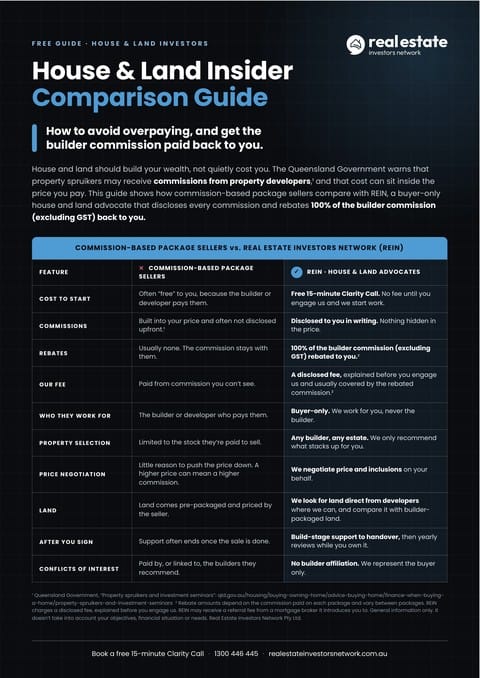
- Who’s paid if I buy? If anyone introduced you to the package, ask in writing whether they’re paid a commission, by whom, and how much. Here’s how hidden commissions in house and land packages work.
How REIN Can Help
You don’t have to work all of this out on your own. REIN acts only for the buyer. Before you sign, we’ll check the package for you:
- Is the price competitive? We compare the land and build price with what similar property is selling for in the area.
- Does it add risk or spread it? We look at how the location and market compare with what you already own.
- Is there a commission in the price? We ask in writing who’s being paid and how much, so you know before you sign.
How we’re paid: a disclosed fee, and 100% of builder commission (excluding GST) rebated to you.
After settlement we offer yearly reviews of the rent, value and finance, so you can see how each property is tracking.
Common Questions About Buying a Second Investment Property
When should I buy my second investment property?
When you could hold both properties through higher rates and a period of vacancy, and still have a cash buffer. There’s no set timeframe.
Should my second investment property be in a different area?
Often it makes sense. Two similar homes in the same market tend to face the same risks at the same time, while different markets can move very differently.
Can I use equity from my first property?
Usually, if your lender agrees and you can service both loans. Equity can fund a deposit, but it isn’t a substitute for a cash buffer.
Does a second loan affect my borrowing capacity?
Yes. Lenders test you at a higher rate across all your debts, and APRA limits how much lending banks can do at high debt-to-income levels.
Can REIN check a second package for me?
Yes. Book a free 15-Minute Clarity Call and we’ll check the price, how it fits with what you own, and any commission built into the package.
Written by Tom Ashby for REIN. Fact-checked against the sources below. Last updated 20 November 2026.
Important disclaimer: This article is general information only, compiled from publicly available sources on the internet. We believe it was accurate at the date of publication, but details change and errors can occur. It is not legal, tax, financial or credit advice and does not take your circumstances into account. Before you rely on anything here, confirm the facts directly with your lender or the government agency concerned, and speak to your accountant, solicitor or licensed adviser. REIN accepts no liability for decisions made on the basis of this article. To report an error, call 1300 446 445.
Sources
- Moneysmart: Buying an investment property (updated 29 September 2026), accessed 20 November 2026
- Reserve Bank of Australia: Cash rate target, accessed 20 November 2026
- APRA: APRA maintains current macroprudential policy settings in highly uncertain environment, 28 May 2026, accessed 20 November 2026
- REIWA: Byford suburb profile (Landgate/REIWA data, 12 months to October 2026), accessed 19 November 2026
- REIV: Melton South suburb insights, accessed 19 November 2026
More buying guides