Quick answer: Yes, you can negotiate a house and land package, but rarely on the headline price. The land and the build are usually separate contracts, so each has its own room to move. The levers that tend to matter more than the price are the inclusions, the prime cost items and provisional sums, site costs, the deposit, the settlement timing and any commission paid on the sale. In Queensland, the building deposit is capped at 5% for most contracts of $20,000 or more. Real Estate Investors Network (REIN), a buyer-only house and land advocate, checks a package before you sign and shows where there is room to negotiate: the land and build price, the inclusions and who is paid from the price.
In this guide (7 sections)
Been shown a house and land package? Run the numbers in 60 seconds.
Free calculator: land and build split, yield, weekly cost and what to check before you sign.
Read this before you sign
- Get the land price and the build price as two numbers, in writing.
- Ask for allowances (PC items and provisional sums) to be priced before you sign, not after.
- Agree every change in writing. A verbal “we’ll throw that in” is worth nothing at handover.
Already been shown a house and land package? Get My Package Checked before you sign.
Most buyers ask for a lower price, hear “it’s already a fixed price package”, and stop there. That is usually the wrong fight. A package is a bundle of a dozen smaller numbers, and the money tends to hide in the ones nobody reads.
This guide covers what you can push on, what usually won’t move, and what to get in writing. It is written for investors buying new house and land in Queensland. Every fact below links to its source.
Can you negotiate a house and land package?
Yes. Most packages are two contracts: a land contract with the developer and a building contract with the builder. Our guide to split contract vs single contract explains the difference. Each side sets its own price and terms, so each is a separate negotiation.
The land price is often the harder one to move, especially in a new release with set price lists. The build side usually has more room, because so much of the final cost sits in inclusions, allowances and site works rather than the base price.
What you can usually negotiate
1. Inclusions
Flooring, window coverings, driveway, fencing, landscaping, air conditioning and appliances are often listed as “included” in one package and as extras in the next. Ask for the full inclusions list for your exact design and lot, and compare it line by line. Asking for an item to be added is often easier than asking for a lower price.
2. Prime cost items and provisional sums
These are allowances, not fixed prices. The QBCC describes prime cost items as fixtures and fittings such as tiling and kitchen appliances, and provisional sums as contracted services such as rock or termite removal (QBCC). Under the QBCC New Home Construction Contract, if the actual cost comes in higher, you pay the difference plus the contractor’s markup. That same contract requires written reasons for each item before work starts if allowances, including markup, exceed 20% of the contract price.
Negotiate this: ask the builder to turn allowances into fixed prices wherever they can, and ask for the markup on each one in writing. Your builder may use a different contract form, so check which one you are signing.
3. Site costs
Site costs depend on the slope, the soil and the services on your lot. If the price was set before a soil test and contour survey, ask what happens when the results come in, and whether the builder will cap site costs in the contract. Our house and land package costs guide lists the usual extras.
4. The deposit
For Queensland domestic building contracts of $20,000 or more, the maximum deposit is generally 5% (QBCC). The land deposit is separate and set by the land contract, so it is open to negotiation. A smaller deposit or a deposit bond keeps more cash free during the build. See our guide to house and land package deposits.
5. Settlement and title timing
If the land is not yet titled, ask for the expected title date in writing and a land settlement period that suits your finance. Queensland’s rules for off-the-plan land set an 18-month limit for the seller to settle (Queensland Government). A finance clause long enough for a valuation is worth asking for.
6. Commission on the sale
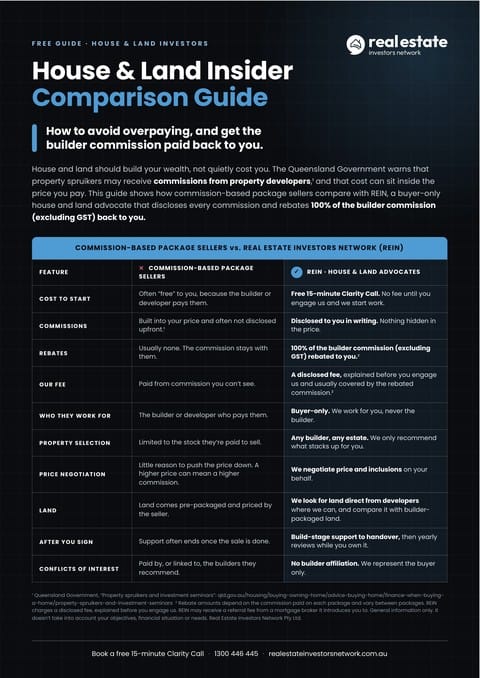
Ask directly whether anyone involved in the sale is paid a commission or fee by the builder or developer, and ask for the answer in writing. REIN rebates 100% of any builder commission (excluding GST) to the buyer, disclosed in writing.
What usually won’t move
- The land price in a busy release. If lots are selling off a published price list, the developer has little reason to drop it for one buyer.
- Legal limits. The 5% building deposit cap, the cooling-off period and home warranty insurance are set by law, not by negotiation. See our QLD home warranty insurance guide.
- The builder’s licence and insurance. These are checks, not bargaining chips. Confirm both on the QBCC licence search.
Get every change in writing
A negotiation is only as good as the document it ends up in. Under the QBCC New Home Construction Contract, a variation must be put in writing and agreed by both parties before the work starts, and the contractor must give you a signed copy within 5 business days. Anything agreed before signing should be in the inclusions list or the special conditions, not in an email or a conversation.
For contracts of $20,000 or more, the builder must give you the QBCC Consumer Building Guide to read before you sign. Read it.
Questions to ask before you sign
- What is the land price and the build price, separately?
- Which items are prime cost items or provisional sums, and what is the markup on each?
- Can any allowance be converted to a fixed price?
- Has a soil test and contour survey been done for this lot? Will site costs be capped?
- Is anyone involved in this sale paid a commission or fee by the builder or developer? How much?
- When will the land be titled, and how long is the finance clause?
- Which contract form is this building contract based on?
Our house and land contract checklist covers the other checks to make before you sign.
How REIN Can Help With Negotiating a House and Land Package
- We split the package into its parts and show you where the numbers sit.
- We check allowances, site costs and the contract terms before you sign.
- Book a free 15-Minute Clarity Call and we’ll explain how we check the price, the commission and the contract. Any builder commission is disclosed in writing and rebated 100% to you (excluding GST).
- A disclosed fee, and 100% of builder commission (excluding GST) rebated to you.
Start with a free 15-Minute Clarity Call.
Common Questions About Negotiating House and Land Packages
Can you negotiate the price of a house and land package?
Sometimes, but the headline price is usually the hardest number to move. The build side tends to have more room than the land, through inclusions, allowances and site costs. Ask for the land and build prices separately, then negotiate each part rather than the total.
Is a “fixed price” house and land package really fixed?
Not always. A package can be fixed price and still contain prime cost items and provisional sums, which are allowances that can go up. Under the QBCC New Home Construction Contract, if an allowance runs over, you pay the difference plus the contractor’s markup. Ask for every allowance to be listed and priced.
Can you negotiate the deposit on a house and land package?
The land deposit is set by the land contract and is often negotiable. For Queensland domestic building contracts of $20,000 or more, the building deposit is generally capped at 5% by law. If a builder asks for more, ask which legal exception applies.
What is easier to negotiate than the price?
Inclusions, fixed prices for allowances, capped site costs, settlement timing and finance clauses are often easier to win than a price cut. Each one can change what you end up paying, and each should be written into the contract.
Should agreed changes be in writing?
Yes. Anything agreed before signing should be in the inclusions list or special conditions. After signing, the QBCC New Home Construction Contract requires variations to be agreed in writing by both parties before the work starts.
REIN is a buyers advocate for investors buying new house and land. We work only for the buyer. Are you comparing packages right now? Send us the one you’re looking at before you sign, or read more on the REIN blog.
More guides
- House and land contract: 12 checks before you sign
- Split contract vs single contract house and land
- House and land package costs
- House and land package deposits
- QLD home warranty insurance
This is general information, not legal, tax or financial advice. Speak to a Queensland property solicitor about your contract before you sign.
Written by Tom Ashby for REIN. Fact-checked against the sources below. Last updated 4 November 2026.
Important disclaimer: This article is general information only, compiled from publicly available sources on the internet. We believe it was accurate at the date of publication, but details change and errors can occur. It is not legal, tax, financial or credit advice and does not take your circumstances into account. Before you rely on anything here, confirm the facts directly with the builder, the developer or the government agency concerned, and speak to your accountant, solicitor or licensed adviser. Ratings, reviews and opinions quoted belong to their authors. REIN accepts no liability for decisions made on the basis of this article. To report an error, call 1300 446 445. A REIN service fee applies to our services, and where REIN receives a builder or developer commission in connection with a client’s purchase, it discloses and rebates 100% (excluding GST) of that commission to the client under its written service agreement.
Sources
- QBCC: Contracts and agreement types, accessed 4 November 2026
- QBCC: QBCC New Home Construction Contract General Conditions (conditions 4 and 21), accessed 4 November 2026
- QBCC: Understanding deposits and progress payments, accessed 4 November 2026
- Queensland Government: Buying off the plan, accessed 4 November 2026
More buying guides