Quick answer: Rental yield is the income a property earns each year as a share of its value. Capital growth is how much its value rises. Over time, growth usually does more for your wealth, but yield decides whether you can afford to hold the property while you wait. From 1 July 2027 the balance shifts: an established home bought after 7:30pm AEST on 12 May 2026 can no longer be negatively geared against your wages, so its cash flow matters more. Qualifying new builds keep negative gearing. Real Estate Investors Network (REIN), a buyer-only house and land advocate, checks house and land packages before you sign: the land and build price, the inclusions and who is paid from the price.
In this guide (8 sections)
This is general information, not financial advice.
Yield and Growth, Explained
- Gross rental yield is the annual rent divided by the property’s value. A $650,000 home renting for $600 a week ($31,200 a year) has a gross yield of 4.8%.
- Net rental yield takes off costs such as rates, insurance, management and repairs first.
- Capital growth is the rise in value. Moneysmart puts it simply: if your property increases in value, you benefit from a capital gain when you sell (Moneysmart).
Been shown a house and land package? Run the numbers in 60 seconds.
Free calculator: land and build split, yield, weekly cost and what to check before you sign.
What the Market Is Doing Now
Cotality’s November 2026 Home Value Index (October data) shows how differently the cities are moving (Cotality):
| Market (all dwellings) | Change in value, 12 months | Gross rental yield |
|---|---|---|
| Sydney | -9.4% | 3.5% |
| Melbourne | -7.6% | 4.1% |
| Brisbane | +0.4% | 3.7% |
| Adelaide | +3.7% | 3.7% |
| Perth | +3.9% | 4.2% |
| Hobart | +5.5% | 4.4% |
| Darwin | +9.7% | 6.4% |
| Canberra | -3.7% | 4.4% |
| Combined regionals | +3.4% | 4.4% |
| National | -2.8% | 3.9% |
Cotality noted that the gross yield across the combined capitals, at 3.77%, was the highest since May 2015. Twelve-month figures move a lot, so don’t buy on one year’s growth.
Where the risk really sits: overpaying, and never knowing you did
A Simple Comparison
These figures are illustrative only. They assume a $650,000 purchase held for 10 years, rent that doesn’t change, and no costs, tax, vacancy or loan.
| Scenario | Gross yield, year 1 | Value after 10 years | Capital gain | Rent over 10 years | Total return |
|---|---|---|---|---|---|
| Higher yield: $600 a week, 3% growth | 4.8% | $873,546 | $223,546 | $312,000 | $535,546 |
| Higher growth: $520 a week, 6% growth | 4.2% | $1,164,051 | $514,051 | $270,400 | $784,451 |
The extra $80 a week of rent adds $41,600 over 10 years. Three extra points of growth add about $290,500. In this example, growth does more over 10 years. But growth only pays when you sell, while the rent has to cover your costs every week. If you can’t hold the property through a flat patch, the growth never arrives.
Why Land Drives Growth
RBA research has found that the value of residential land in Australia is about twice the value of the homes built on it, (RBA, 2018), and that in Sydney, Melbourne, Brisbane and Perth the building’s share of average house prices has declined substantially since the early 2000s (RBA, 2018). Buildings, by contrast, wear out. The ATO lets investors claim capital works on the building at 2.5% a year for 40 years (ATO).
For a house and land package, that means the land is what’s most likely to grow in value. Check how much of the price is land, and what similar lots nearby have sold for.
Want the land and build split checked? Book a free 15-min Clarity Call →.
How the 2026 Tax Changes Shift the Balance
The ATO says the negative gearing and capital gains tax (CGT) changes “are now law” (ATO).
- Established homes bought after 7:30pm AEST on 12 May 2026: from 1 July 2027, losses can’t be offset against wages, though they can be carried forward. Separately, for gains accruing after 1 July 2027, the 50% CGT discount for individuals, trusts and partnerships is replaced by cost base indexation and a 30% minimum tax, whenever the property was bought. A growth-first, negatively geared strategy is less attractive, so yield matters more.
- Qualifying new builds: they can still be negatively geared, and the Budget explainer says new-build investors can choose the 50% discount or the new arrangements (Budget 2026-27). That keeps the case for growth.
The legal definition of a new build is in a Bill that was before the Senate on 25 November 2026 (Parliament of Australia), so confirm how your purchase will be treated with your accountant. Our negative gearing changes guide has more.
Not ready to check a house and land package yet?
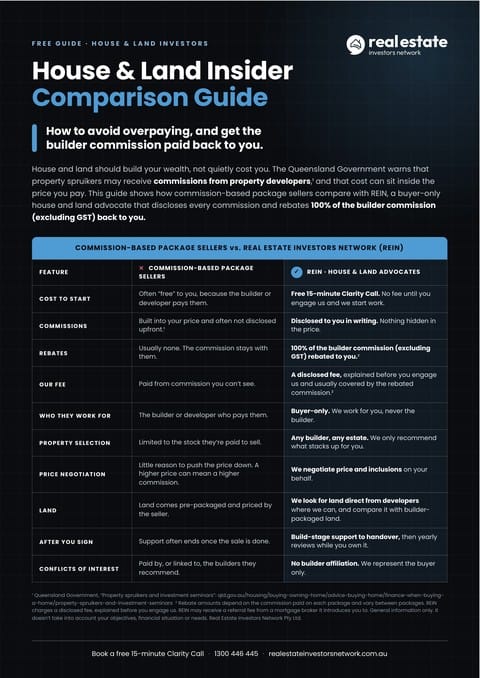
Get the House & Land Insider Comparison Guide: 14 checks to run before you sign, and how to get the builder’s commission paid back to you.
General information only. Unsubscribe any time.
Which Should You Prioritise?
- Start with what you can hold. Work out the weekly cost after rent at a higher interest rate. Our stress test guide shows how.
- Then look for growth drivers you can check: land value, how much new supply is coming, jobs and transport.
- Be wary of yields that look too high. A high yield in an estate with lots of new homes still to come can fall as supply arrives.
- Don’t overpay. Paying above value cuts both your yield and your growth. These six checks for an overpriced package help.
How REIN Can Help
REIN works only for the buyer. Before you sign, we’ll look at:
- The price. We compare the land and build price with recent sales of similar property nearby.
- The rent. We test the rent estimate against what comparable homes in the area are renting for.
- The commission. We ask in writing who is being paid from the price and how much, so you know before you sign.
How we’re paid: a disclosed fee, and 100% of builder commission (excluding GST) rebated to you.
Common Questions About Capital Growth and Rental Yield
Is capital growth or rental yield more important?
Over a long hold, growth usually adds more wealth. But yield decides whether you can afford to keep the property, and from 1 July 2027 it matters more for established homes bought after 12 May 2026.
What is a good rental yield in Australia?
There’s no single answer. Cotality put the national gross yield at 3.9% in October 2026, with capital cities ranging from 3.5% in Sydney to 6.4% in Darwin.
How do I calculate rental yield?
Divide the annual rent by the property’s value. $600 a week on a $650,000 home is $31,200 a year, a gross yield of 4.8%.
Do new builds have better growth?
Not automatically. The land is what usually grows. In estates with a lot of new supply, prices can be held back while lots are still being released.
Written by Tom Ashby for REIN. Last updated 25 November 2026.
Important disclaimer: This article is general information only, compiled from publicly available sources. We believe it was accurate at the date of publication, but market data and tax rules change and errors can occur. It is not financial, tax or legal advice and does not take your circumstances into account. The comparison uses assumed figures for illustration only, and past growth doesn’t predict future growth. REIN accepts no liability for decisions made on the basis of this article. To report an error, call 1300 446 445.
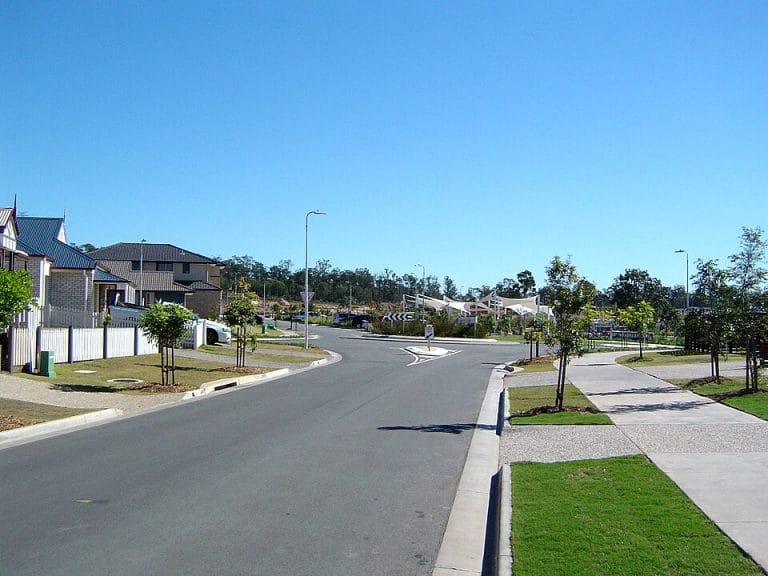
Image: Neb, CC BY-SA 4.0, via Wikimedia Commons.
Sources
- Moneysmart: Buying an investment property, accessed 25 November 2026
- Cotality: Home Value Index, November 2026 (October data), accessed 25 November 2026
- RBA: Decomposing property values into dwelling structure and land, 2018, accessed 25 November 2026
- ATO: Capital works deductions, accessed 25 November 2026
- ATO: Tax reform, negative gearing and CGT, accessed 25 November 2026
- Budget 2026-27: Tax explainer, negative gearing and CGT, accessed 25 November 2026
- Parliament of Australia: Treasury Laws Amendment (Tax Reform No. 3) Bill 2026, accessed 25 November 2026
More buying guides