Quick answer: Most lenders expect a 20% deposit on an investment property. Put down less and you’ll usually pay lenders mortgage insurance (LMI), which protects the lender, not you. On a $650,000 house and land package, 20% is $130,000, and stamp duty and other buying costs come on top of that. If you already own a home, you may be able to use its equity instead of cash. Real Estate Investors Network (REIN), a buyer-only house and land advocate, checks house and land packages before you sign: the land and build price, the inclusions and who is paid from the price.
In this guide (7 sections)
This is general information, not credit advice. Your lender or broker will confirm the deposit that applies to you.
The 20% Rule and Lenders Mortgage Insurance
Westpac puts it simply: lenders “will generally expect you to have access to a deposit of 20% of the purchase price”, and LMI is generally required below that (Westpac). CommBank says LMI usually applies once the loan is more than 80% of the property’s value, that it protects the bank rather than the borrower, and that it generally costs between 1% and 5% of the loan amount (CommBank).
Rules and premiums vary from lender to lender, and investment loans can be treated differently from home loans. Ask before you assume.
Been shown a house and land package? Run the numbers in 60 seconds.
Free calculator: land and build split, yield, weekly cost and what to check before you sign.
Worked Example: Three Deposits on a $650,000 Package
The figures below are for illustration. The LMI range applies CommBank’s general 1% to 5% guide to the loan amount. Your actual premium will depend on the lender and the loan.
| Deposit | Deposit amount | Loan | Loan-to-value | LMI likely? |
|---|---|---|---|---|
| 20% | $130,000 | $520,000 | 80% | Usually not |
| 10% | $65,000 | $585,000 | 90% | Usually yes, roughly $5,850 to $29,250 |
| 5% | $32,500 | $617,500 | 95% | Usually yes, and not every lender will go this high |
The deposit is only part of the cash you’ll need. Moneysmart’s list of costs to buy and sell a property includes stamp duty, conveyancing and legal fees, search fees, and pest and building reports (Moneysmart). On a new build, stamp duty can work differently, so read our guide to stamp duty on new builds before you set your budget.
Where the risk really sits: overpaying, and never knowing you did
Using Equity Instead of Cash
If your home has gone up in value, a lender may let you borrow against that equity to cover the deposit and costs on an investment. You’re still borrowing the money, so your total debt goes up, and you’ll be paying two loans. Using equity to buy an investment property walks through how lenders work out what you can access.
Can You Afford the Repayments, Not Just the Deposit?
Saving the deposit gets you in the door. Holding the property is the harder part.
- Interest-only periods end. Moneysmart notes that many investors use interest-only loans, but the interest-only period ends after a set time (Moneysmart). After that you start paying off the loan itself, so the repayments go up.
- Allow for weeks without a tenant. Moneysmart’s advice is not to rely on rent to cover the mortgage, because there may be times when the property is empty (Moneysmart).
- Allow for higher rates. APRA expects lenders to check that new borrowers could still meet repayments at a rate at least 3 percentage points above their loan rate (APRA, October 2021), and it kept that buffer at 3 percentage points in May 2026 (APRA, 28 May 2026).
Put your own numbers into the investment property cost calculator to see the weekly cost, then see how it holds up if rates rise.
Already found a package? Book a free 15-min Clarity Call →.
Not ready to check a house and land package yet?
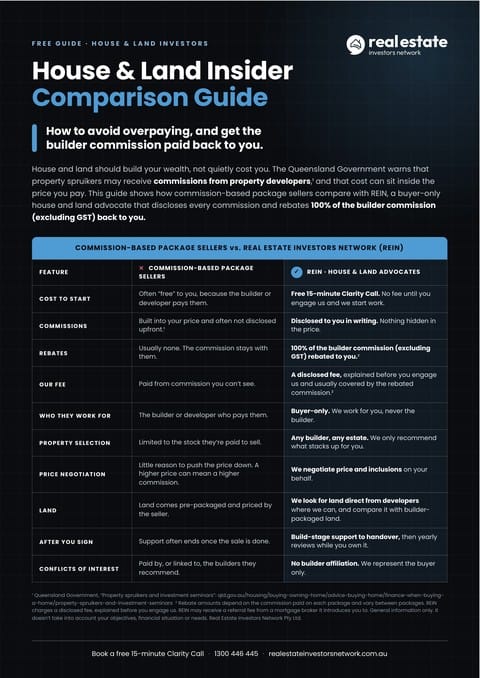
Get the House & Land Insider Comparison Guide: 14 checks to run before you sign, and how to get the builder’s commission paid back to you.
General information only. Unsubscribe any time.
Five Questions to Ask Before You Commit Your Deposit
- How much will the lender lend on this property? Find out before you sign, not after.
- Will you pay LMI, and how much? Get the figure in writing from your lender or broker.
- How much cash do you need on top of the deposit? Stamp duty, legal fees and reports can add thousands.
- Is the price right? If you overpay, part of your deposit is gone the day you settle. These six checks for an overpriced package are a good place to start.
- Who is paid from the price? If someone introduced you to the package, ask them in writing whether they’re paid a commission, who pays it and how much.
How REIN Can Help
REIN works only for the buyer. Before you put your deposit down, we’ll look at:
- The price. We compare the land and build price with recent sales of similar property nearby.
- The rent. We test the rent estimate against what comparable homes in the area are renting for.
- The commission. We ask in writing who is being paid from the price and how much, so you know before you sign.
How we’re paid: a disclosed fee, and 100% of builder commission (excluding GST) rebated to you.
Common Questions About Investment Property Deposits
Can I buy an investment property with a 10% deposit?
Some lenders will lend with a 10% deposit, but you’ll usually pay LMI when it’s under 20%. Your lender or broker can tell you what applies to an investment loan.
Is LMI added to my loan?
That depends on the lender. CommBank adds its premiums to the loan at settlement. Westpac says LMI can be paid upfront or added to the loan.
Does stamp duty count as part of the deposit?
No. Stamp duty and other buying costs are paid on top of the deposit, so you need to budget for both.
Can REIN check a package before I commit my deposit?
Yes. Get My Package Checked and we’ll look at the price, the rent estimate and any commission in the package before you sign.
Written by Tom Ashby for REIN. Fact-checked against the sources below. Last updated 24 November 2026.
Important disclaimer: This article is general information only, compiled from publicly available sources. We believe it was accurate at the date of publication, but lender policies change and errors can occur. It is not credit, financial, tax or legal advice and does not take your circumstances into account. The worked example uses assumed figures for illustration only. Before you rely on anything here, speak to your lender, a licensed mortgage broker or your accountant. REIN accepts no liability for decisions made on the basis of this article. To report an error, call 1300 446 445.
Sources
- Westpac: Lenders Mortgage Insurance, accessed 24 November 2026
- CommBank: Lenders mortgage insurance (updated 9 November 2026), accessed 24 November 2026
- Moneysmart: Buying an investment property, accessed 24 November 2026
- APRA: Loan serviceability expectations, 6 October 2021, accessed 24 November 2026
- APRA: Macroprudential policy settings, 28 May 2026, accessed 24 November 2026
More buying guides