Quick answer: How much you can borrow for an investment property depends on your income, your living expenses, your existing debts (including credit card limits), your deposit and the rent the property is expected to earn. Lenders don’t test you at your actual interest rate. APRA expects them to check you could still make repayments at a rate at least 3 percentage points higher. On a $600,000 loan at 7.19%, that lifts the assessed repayment from about $4,069 to about $5,350 a month. Real Estate Investors Network (REIN), a buyer-only house and land advocate, checks house and land packages before you sign: the land and build price, the inclusions and who is paid from the price.
In this guide (9 sections)
- What Lenders Look At
- The 3% Buffer: Why You Can Borrow Less Than You Think
- Debt-to-Income Limits
- How Lenders Count Rental Income
- Investor Loans Cost a Little More
- Borrowing for a House and Land Package
- Five Things That Can Affect How Lenders Assess You
- How REIN Can Help
- Common Questions About Borrowing for an Investment Property
This is general information, not credit advice. A licensed mortgage broker or your lender can tell you what you can borrow.
What Lenders Look At
Under responsible lending rules, lenders must make reasonable inquiries about your financial situation, take reasonable steps to verify it, and assess whether the loan is not unsuitable for you (ASIC). In practice, they look at:
- Your income. Salary, other income and, for an investment, the expected rent.
- Your expenses. Lenders compare what you declare with benchmarks. NAB’s borrowing calculator, for example, uses the Household Expenditure Measure (HEM) figure if the living expenses you enter are lower (NAB).
- Your debts. Existing home loans, car loans and personal loans all reduce what you can borrow.
- Your credit card limits. Westpac says credit card and loan limits count as debt, even if you don’t owe anything on them (Westpac). Cutting an unused limit can help.
- Your deposit and credit history. Moneysmart lists your deposit, savings, and credit score and report among the things that affect your borrowing (Moneysmart).
Been shown a house and land package? Run the numbers in 60 seconds.
Free calculator: land and build split, yield, weekly cost and what to check before you sign.
The 3% Buffer: Why You Can Borrow Less Than You Think
In October 2021 APRA told lenders to assess new borrowers at an interest rate at least 3 percentage points above the loan’s rate (APRA, October 2021). In May 2026 APRA said the buffer would remain at 3 percentage points (APRA, 28 May 2026).
The table shows the effect on one loan. The rate is CommBank’s standard variable rate for an investment principal and interest loan at 70% to 80% of the property’s value, effective 13 November 2026 (CommBank). Your lender’s rate will differ.
| $600,000 loan, 30 years, principal and interest | Interest rate | Monthly repayment |
|---|---|---|
| What you’d actually pay | 7.19% | $4,069 |
| What the lender tests you at | 10.19% | $5,350 |
| Difference | $1,281 a month |
Repayments are calculated with the standard loan formula and rounded to the nearest dollar. This shows the effect of the buffer only. It isn’t anyone’s borrowing capacity.
Where the risk really sits: overpaying, and never knowing you did
Debt-to-Income Limits
From 1 February 2026, APRA limited the share of new loans that banks and other lenders can make at six times the borrower’s income or more to 20%. The limit applies separately to owner-occupier and investor loans (APRA, November 2025). In May 2026 APRA left the limits unchanged and said high debt-to-income lending was well below them (APRA).
It isn’t a cap on any one borrower. It limits how much high debt-to-income lending each lender can do.
How Lenders Count Rental Income
Lenders don’t count all the rent. They reduce it to allow for vacancies and costs, which is called shading. How much varies:
- Westpac’s broker policy applies 5% rental income shading where verified rent is used (Westpac).
- Macquarie counts 95% of residential rent and applies a minimum 15% of rent for property expenses. For a new purchase, it uses the lowest of the valuer’s figure, an agent’s estimate or a tenancy agreement (Macquarie).
The lowest rent estimate matters on a house and land package. If the package was sold on a rent figure the valuer won’t support, your borrowing can come in lower than you planned.
Found a package and want the numbers tested? Book a free 15-min Clarity Call →.
Investor Loans Cost a Little More
At CommBank, the standard variable rate for an investment principal and interest loan at 70% to 80% of value is 7.19%, against 6.99% for an owner-occupier at the same level (CommBank, effective 13 November 2026). The RBA lifted the cash rate to 4.85% on 3 November 2026 (RBA).
If you’re considering an interest-only loan, Moneysmart warns that the rate could be higher than on a principal and interest loan, and that repayments increase when the interest-only period ends (Moneysmart).
Not ready to check a house and land package yet?
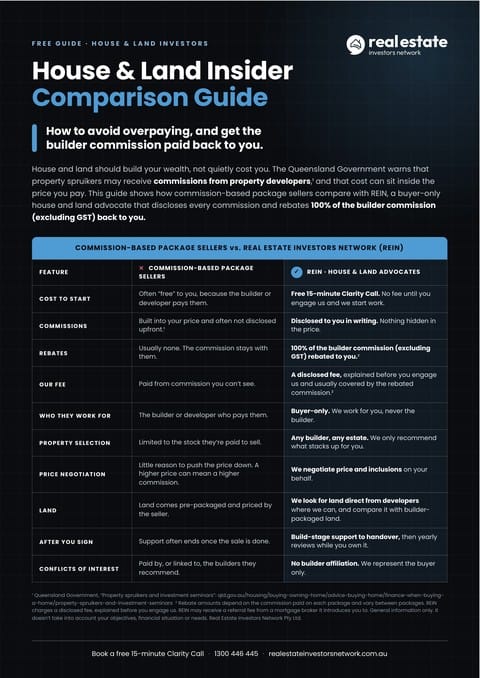
Get the House & Land Insider Comparison Guide: 14 checks to run before you sign, and how to get the builder’s commission paid back to you.
General information only. Unsubscribe any time.
Borrowing for a House and Land Package
A package is usually funded with a land loan and a construction loan, which changes how the money moves:
- Interest is charged as the build is paid. CommBank and NAB charge interest only on the amount drawn down so far (CommBank; NAB).
- The lender values the finished home before you start. NAB values the proposed work before building starts and again at the first and final progress claims (NAB). Westpac says cost increases usually need credit approval (Westpac).
- A low valuation can mean a bigger deposit. If the valuation comes in below the price, you may need to put in more of your own money.
- Build time limits apply. CommBank, for example, requires the build to be finished within 24 months of the first progress payment (CommBank).
Our construction loan guide covers progress payments in more detail, and our deposit guide covers how much you’ll need up front.
Five Things That Can Affect How Lenders Assess You
A licensed broker can tell you which of these matter for your application.
- Unused credit card limits. Lenders such as Westpac count the limit, not the balance.
- Small debts such as car or personal loans reduce what you can borrow.
- Know your real living expenses. Lenders compare what you declare with the HEM benchmark.
- Use a realistic rent figure. Base it on what similar homes nearby are renting for, not the brochure.
- Don’t overpay. A price above value can lead to a low valuation and a bigger deposit. These six checks for an overpriced package are a good start.
How REIN Can Help
REIN works only for the buyer. Before you commit your borrowing to a package, we’ll look at:
- The price. We compare the land and build price with recent sales of similar property nearby.
- The rent. We test the rent estimate against what comparable homes in the area are renting for.
- The commission. We ask in writing who is being paid from the price and how much, so you know before you sign.
How we’re paid: a disclosed fee, and 100% of builder commission (excluding GST) rebated to you.
Common Questions About Borrowing for an Investment Property
How much can I borrow for an investment property?
It depends on your income, expenses, debts, deposit and the expected rent, tested at your loan rate plus at least 3 percentage points. A licensed broker or your lender can work out your figure.
Do lenders count the rent from the investment?
Yes, but not all of it. Lenders shade rent to allow for vacancies and costs, and the amount varies by lender.
Do credit cards affect how much I can borrow?
They can. Lenders such as Westpac count credit card limits as debt even if the balance is zero.
Is there a limit on how much I can borrow compared to my income?
Not a personal cap. Since February 2026, APRA limits banks and other lenders to 20% of new lending at six times income or more, separately for investors and owner-occupiers.
Is it harder to borrow for a house and land package?
It can be. The lender values the finished home before the build starts, and a low valuation can mean you need a bigger deposit.
Written by Tom Ashby for REIN. Last updated 25 November 2026.
Important disclaimer: This article is general information only, compiled from publicly available sources. We believe it was accurate at the date of publication, but lender policies and rates change and errors can occur. It is not credit, financial, tax or legal advice and does not take your circumstances into account. The worked example uses assumed figures for illustration only. Before you rely on anything here, speak to your lender or a licensed mortgage broker. REIN accepts no liability for decisions made on the basis of this article. To report an error, call 1300 446 445.
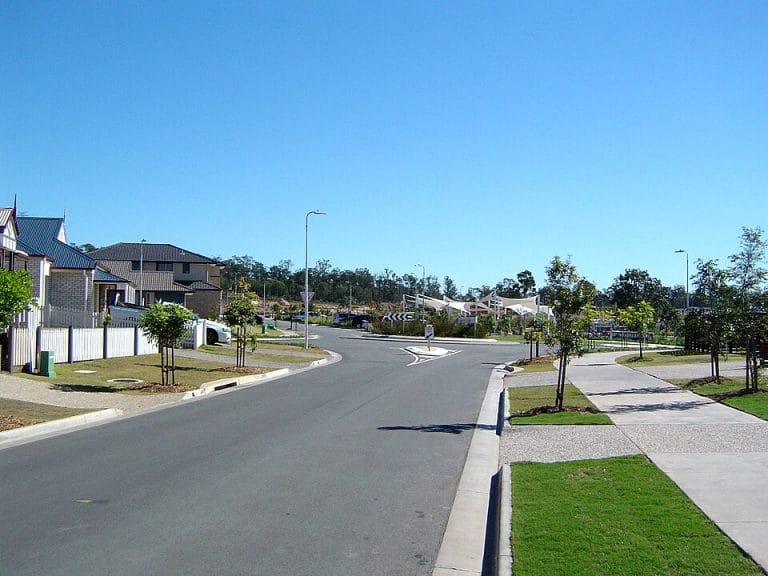
Image: Kgbo, CC BY-SA 4.0, via Wikimedia Commons.
Sources
- ASIC: Responsible lending, accessed 25 November 2026
- APRA: Loan serviceability expectations, 6 October 2021, accessed 25 November 2026
- APRA: Limit on high debt-to-income home loans, November 2025, accessed 25 November 2026
- APRA: Macroprudential policy settings, 28 May 2026, accessed 25 November 2026
- RBA: Monetary policy decision, 3 November 2026, accessed 25 November 2026
- CommBank: Standard variable rates, accessed 25 November 2026
- CommBank: Construction loans, accessed 25 November 2026
- NAB: Borrowing calculator terms, accessed 25 November 2026
- NAB: Construction loans, accessed 25 November 2026
- Westpac: Borrowing calculator, accessed 25 November 2026
- Westpac: Broker policy, accessed 25 November 2026
- Westpac: What is a construction loan, accessed 25 November 2026
- Macquarie: Investment income servicing, accessed 25 November 2026
- Moneysmart: Buying a house, accessed 25 November 2026
- Moneysmart: Interest-only home loans, accessed 25 November 2026
More buying guides