Quick answer: With an interest-only investment loan, your repayments cover only the interest for a set period, often five years, so you pay nothing off the loan. Repayments are lower at first, but they jump when the loan switches to principal and interest, and you pay more interest overall. On a $600,000 loan at 7.4%, five years interest-only costs about $45,000 more in interest over 30 years than paying principal and interest from the start. Real Estate Investors Network (REIN), a buyer-only house and land advocate, checks house and land packages before you sign: the land and build price, the inclusions and who is paid from the price.
In this guide (8 sections)
This is general information, not credit advice. A licensed mortgage broker or your lender can tell you what suits your situation.
How an Interest-Only Loan Works
Moneysmart explains that on an interest-only loan “your repayments only cover interest on the amount borrowed”. For a set period, for example five years, you pay nothing off the loan itself. At the end of that period, the loan changes to principal and interest, which means higher repayments (Moneysmart).
Lenders set their own limits. CommBank, for example, says the maximum interest-only period at any one time is five years, and up to 15 years in total for investors (CommBank). ANZ lists interest-only terms of one to five, seven and 10 years for investment loans (ANZ).
Been shown a house and land package? Run the numbers in 60 seconds.
Free calculator: land and build split, yield, weekly cost and what to check before you sign.
What It Costs: A Worked Example
The table compares a $600,000 loan over 30 years at an assumed 7.4%, held constant. That rate sits within the range of Westpac’s current interest-only investment rates (see below). It ignores fees, offset accounts and rate changes.
| Principal and interest from day one | 5 years interest-only, then principal and interest | |
|---|---|---|
| Repayment, years 1 to 5 | $4,154 a month | $3,700 a month |
| Repayment, years 6 to 30 | $4,154 a month | $4,395 a month |
| Loan owing after 5 years | $567,138 | $600,000 |
| Total interest over 30 years | $895,540 | $940,498 |
Repayments are calculated with the standard loan formula and rounded to the nearest dollar. The interest-only borrower saves $454 a month for five years, then pays $695 a month more than before and $241 a month more than the principal and interest borrower for the next 25 years. ASIC’s 2015 review gave a similar example: on a $500,000 loan at 6% over 30 years, a five-year interest-only period added $37,226 in interest (ASIC).
Where the risk really sits: overpaying, and never knowing you did
Interest-Only Rates Are Usually Higher
Moneysmart warns that the interest rate could be higher than on a principal and interest loan, so you pay more over the life of the loan (Moneysmart). CommBank says interest-only rates tend to be higher (CommBank).
For example, on 25 November 2026, Westpac’s discounted variable rates on its Flexi First Option Investment Property Loan at 70% to 80% of the property’s value were 7.84% interest-only and 7.34% principal and interest (Westpac). The RBA lifted the cash rate to 4.85% on 3 November 2026 (RBA).
Why Investors Use Interest-Only Loans
- Lower repayments during the interest-only period. That can help cash flow, especially while a new build is being finished and leased.
- Interest on a rental loan is deductible. The ATO says you can claim the interest charged on a loan used for a rental property, but you must separate any interest on money used for private purposes (ATO).
- Cash can go elsewhere. Some investors pay down a non-deductible home loan instead. Whether that suits you is a question for your broker and accountant.
Checking a package and how you’ll fund it? Book a free 15-min Clarity Call →.
The Risks
- No equity from repayments. Moneysmart says that if your property doesn’t increase in value during the interest-only period, you won’t build up any equity (Moneysmart).
- The repayment jump. When the period ends, repayments rise because you’re paying off the full loan over fewer years.
- Extending isn’t guaranteed. ANZ, for example, says switching to or extending an interest-only period requires an eligibility assessment (ANZ). ASIC said lenders must take into account the higher repayments once the interest-only period ends when they assess whether you can afford a loan (ASIC).
- The serviceability buffer still applies. APRA expects lenders to test borrowers at a rate at least 3 percentage points above the loan rate, and kept that buffer in May 2026 (APRA). See how much you can borrow for an investment property.
Not ready to check a house and land package yet?
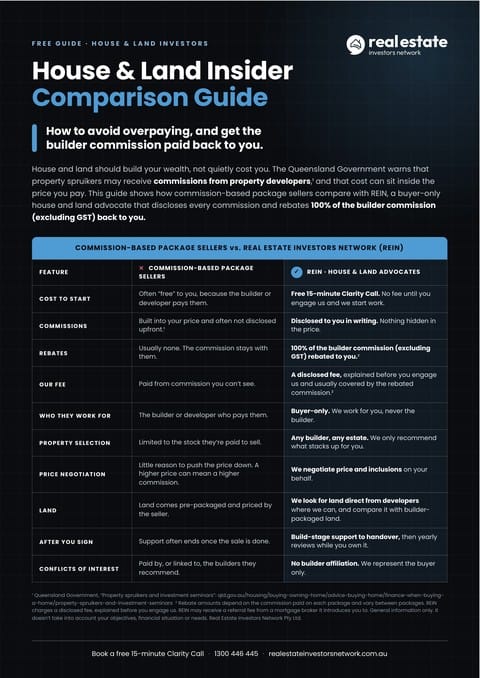
Get the House & Land Insider Comparison Guide: 14 checks to run before you sign, and how to get the builder’s commission paid back to you.
General information only. Unsubscribe any time.
Five Questions to Ask Before You Choose
- What’s the rate gap? Compare the interest-only and principal and interest rates on the same loan.
- What will repayments be when the period ends? Ask for the figure in writing.
- Can you afford that higher repayment now? If not, plan for it before you buy.
- Is the loan split correctly? Keep investment borrowing separate from private borrowing so the interest stays deductible.
- Is the price right? Interest-only won’t help if you overpay. These six checks for an overpriced package are a good start.
How REIN Can Help
REIN works only for the buyer. Before you sign, we’ll look at:
- The price. We compare the land and build price with recent sales of similar property nearby.
- The rent. We test the rent estimate against what comparable homes in the area are renting for.
- The commission. We ask in writing who is being paid from the price and how much, so you know before you sign.
How we’re paid: a disclosed fee, and 100% of builder commission (excluding GST) rebated to you.
Common Questions About Interest-Only Investment Loans
How long can an investment loan be interest-only?
It depends on the lender. CommBank allows up to five years at a time and up to 15 years in total for investors. ANZ lists terms of up to 10 years for investment loans.
Are interest-only loans more expensive?
Usually. The rate is often higher, and because you don’t pay down the loan during the interest-only period, you pay more interest overall.
What happens when the interest-only period ends?
The loan switches to principal and interest, and repayments rise. You can ask for another interest-only period, but the lender has to approve it.
Is the interest tax deductible?
Interest on money borrowed for a rental property is generally deductible. Interest on any part used for private purposes isn’t.
Written by Tom Ashby for REIN. Last updated 25 November 2026.
Important disclaimer: This article is general information only, compiled from publicly available sources. We believe it was accurate at the date of publication, but lender policies and rates change and errors can occur. It is not credit, financial, tax or legal advice and does not take your circumstances into account. The worked example uses assumed figures for illustration only. Before you rely on anything here, speak to your lender or a licensed mortgage broker. REIN accepts no liability for decisions made on the basis of this article. To report an error, call 1300 446 445.
Image: Kgbo, CC BY-SA 4.0, via Wikimedia Commons.
Sources
- Moneysmart: Interest-only home loans, accessed 25 November 2026
- CommBank: Interest only home loans, accessed 25 November 2026
- ANZ: Interest only repayments, accessed 25 November 2026
- Westpac: Home loan interest rates, accessed 25 November 2026
- RBA: Monetary policy decision, 3 November 2026, accessed 25 November 2026
- ASIC: Interest-only loan review, August 2015, accessed 25 November 2026
- APRA: Macroprudential policy settings, 28 May 2026, accessed 25 November 2026
- ATO: Interest expenses, accessed 25 November 2026
More buying guides