Quick answer: Before you buy an investment property, check five things: the money (deposit, borrowing, and holding costs during the build), the location (vacancy, rents and new supply), the package (price, inclusions and who is paid from it), the contract (deposit caps, cooling-off and sunset clauses), and the builder (licence and home warranty insurance). Since the 2026 tax changes, also check whether the property is a new build: from 1 July 2027, an established home bought after 7:30pm AEST on 12 May 2026 can’t be negatively geared against your wages. Real Estate Investors Network (REIN), a buyer-only house and land advocate, checks house and land packages before you sign: the land and build price, the inclusions and who is paid from the price.
In this guide (8 sections)
This is general information, not financial, tax or legal advice.
The Money: Checks 1 to 4
- Know what you can borrow at a higher rate. Lenders must test you at a rate at least 3 percentage points above your loan rate, and APRA kept that buffer at 3 points in May 2026 (APRA). See how much you can borrow for an investment property.
- Budget two deposits. House and land packages normally have a two-part contract, and each part usually needs its own deposit (SA Government HomeSeeker). Our deposit guide walks through the cash you’ll need.
- Cost the build period. You may pay land loan interest, rates and land tax for months before you get rent. Since 1 July 2019 the ATO doesn’t let you claim the costs of holding vacant land, such as interest on the land loan, until the home can lawfully be occupied and is rented or available for rent (ATO).
- Keep a cash buffer. Moneysmart says not to rely on rental income to cover the mortgage, because there may be times the property is empty (Moneysmart).
Been shown a house and land package? Run the numbers in 60 seconds.
Free calculator: land and build split, yield, weekly cost and what to check before you sign.
The Location: Checks 5 to 7
- Check the vacancy rate. SQM Research put the national vacancy rate at 1.5% in October 2026, with Brisbane at 1.0% and Perth and Adelaide at 0.6% (SQM Research). Look up the postcode, and compare it over several years.
- Check how much new supply is coming. In Queensland, the Government Statistician publishes lot approvals, registrations and expected dwelling yield for the council areas it monitors (QGSO). In a big growth area, your home may compete with hundreds of new ones for tenants and buyers.
- Check real rents, not estimates. Use bond data where you can. NSW Rent Check, for example, uses rental bond information from the last three months (NSW Government).
Where the risk really sits: overpaying, and never knowing you did
The Package: Checks 8 to 11
- Compare the price with real sales. In NSW you can search property sales back to 2001 through the Valuer General (NSW Government). Compare similar homes nearby, not the display village. Our six checks for an overpriced package show how.
- Read exactly what’s included. Check finishes, fittings, driveways, fencing and stormwater. HomeSeeker also warns you may pay more to build in bushfire or flood-prone areas (SA Government HomeSeeker).
- Watch the allowances. Consumer Affairs Victoria warns that items with an unknown price, called provisional sums, can blow your budget and cause delays (Consumer Affairs Victoria).
- Ask who is paid from the price. The Queensland Government warns that a property spruiker may be receiving commissions or inducements from property developers, which can affect the advice they give (Queensland Government). Ask in writing whether anyone who introduced you is paid, and how much.
Want someone to run these checks on your package? Book a free 15-min Clarity Call →.
The Contract: Checks 12 to 15
- Know whether it’s one contract or two. Split contracts are common, but don’t assume you’ll only pay stamp duty on the land. Revenue NSW’s ruling DUT 018 explains when duty is charged on both the land and the house (Revenue NSW). See our split vs single contract guide.
- Check the deposit is within the limit. On building contracts over $20,000, Queensland caps the deposit at 5% (QBCC), Victoria at 5% for contracts of $20,000 or more (Consumer Affairs Victoria), and NSW at 10% (NSW Government).
- Know your cooling-off period. In Queensland you have five business days on a building contract (QBCC). NSW off-the-plan buyers have 10 business days (NSW Government). It varies by state and contract type, so check yours before you sign.
- Check the sunset date and when the land will be titled. In Queensland, if an off-the-plan lot hasn’t settled within 18 months of signing, you can generally end the contract (Queensland Government). Untitled land can delay the start of the build. Our sunset clause guide explains the rules by state.
The Builder: Checks 16 and 17
- Check the licence. NSW says to use its online licence check before you sign a contract (NSW Government). In Queensland, search the QBCC licence register (QBCC).
- Check the home warranty insurance. In Queensland, most residential building work over $3,300 is covered by the QBCC scheme (QBCC). Victoria’s new Home Warranty Scheme, run by the Building and Plumbing Commission, started on 1 July 2026 for contracts over $20,000 (vic.gov.au). In NSW, for work over $20,000, the builder must give you a certificate under the Home Building Compensation scheme (NSW Government).
Not ready to check a house and land package yet?
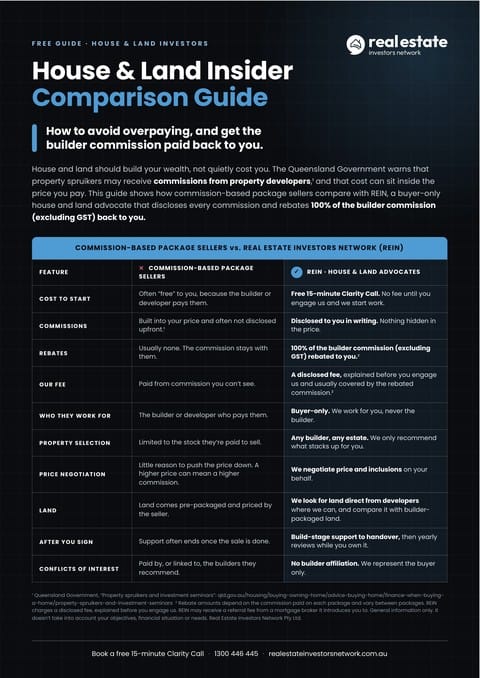
Get the House & Land Insider Comparison Guide: 14 checks to run before you sign, and how to get the builder’s commission paid back to you.
General information only. Unsubscribe any time.
Tax and Exit: Checks 18 to 20
- Confirm it’s a new build if you need negative gearing. From 1 July 2027, a property bought after 7:30pm AEST on 12 May 2026 can only be negatively geared against other income if it’s a new build. Properties held before then are exempt. The ATO says “These measures are now law” (ATO). The Budget explainer says a new build that has been sold before generally won’t qualify for later buyers (Budget 2026-27), so check with your accountant whether your property meets the definition.
- Know when depreciation starts. Capital works on a home where construction started after 15 September 1987 are claimed at 2.5% a year for 40 years, but only once construction is complete (ATO).
- Think about selling. Moneysmart notes entry and exit costs such as stamp duty, legal fees and agent’s fees (Moneysmart). In an estate that’s still releasing land, you may be competing with brand new homes when you sell.
How REIN Can Help
REIN works only for the buyer. Before you sign, we’ll look at:
- The price. We compare the land and build price with recent sales of similar property nearby.
- The rent. We test the rent estimate against what comparable homes in the area are renting for.
- The commission. We ask in writing who is being paid from the price and how much, so you know before you sign.
How we’re paid: a disclosed fee, and 100% of builder commission (excluding GST) rebated to you.
Common Questions About Buying an Investment Property
What should I check before buying an investment property?
Your borrowing at a higher rate, holding costs, vacancy and rents in the area, new supply nearby, the price against real sales, the inclusions, who is paid from the price, the contract terms and the builder’s licence and insurance.
What’s different about checking a house and land package?
You usually sign two contracts and pay two deposits, you carry costs during the build that you may not be able to claim, and the price may include a commission paid to someone who introduced you, so ask in writing.
Does the 2026 tax change affect which property I should buy?
It can. From 1 July 2027, losses on established homes bought after 7:30pm AEST on 12 May 2026 can’t be offset against wages, while qualifying new builds can still be negatively geared.
Can REIN check a package for me?
Yes. Get My Package Checked and we’ll look at the price, the rent estimate and any commission in the package before you sign.
Written by Tom Ashby for REIN. Last updated 25 November 2026.
Important disclaimer: This article is general information only, compiled from publicly available sources. We believe it was accurate at the date of publication, but rules and market data change and errors can occur. It is not financial, tax, credit or legal advice and does not take your circumstances into account. Before you rely on anything here, speak to a solicitor or conveyancer, your accountant and a licensed mortgage broker. REIN accepts no liability for decisions made on the basis of this article. To report an error, call 1300 446 445.
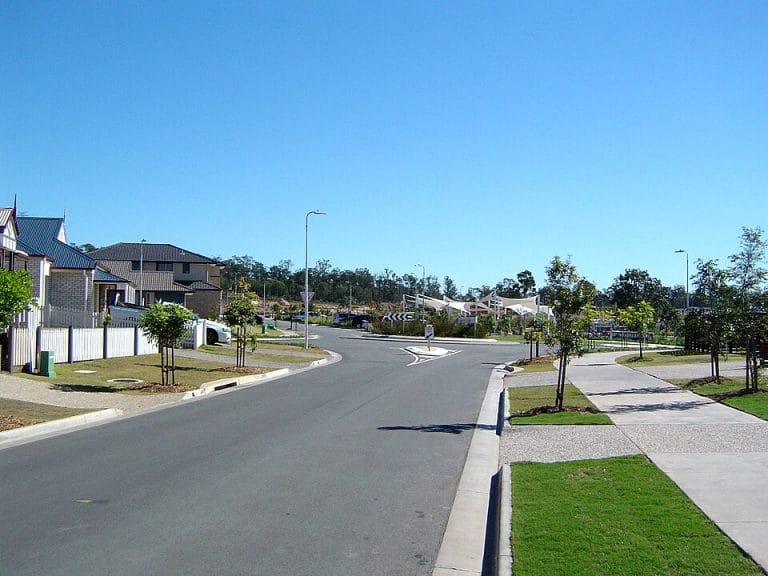
Image: Kerry Raymond, CC BY 3.0, via Wikimedia Commons.
Sources
- APRA: Macroprudential policy settings, 28 May 2026, accessed 25 November 2026
- SA Government HomeSeeker: Buying a house and land package, accessed 25 November 2026
- ATO: Deductions for vacant land, accessed 25 November 2026
- Moneysmart: Buying an investment property, accessed 25 November 2026
- SQM Research: National vacancy rates, October 2026, accessed 25 November 2026
- QGSO: Residential land supply and development, accessed 25 November 2026
- NSW Government: Rent Check, accessed 25 November 2026
- NSW Government: Property sales information, accessed 25 November 2026
- Consumer Affairs Victoria: Managing project costs, accessed 25 November 2026
- Queensland Government: Property spruikers and investment seminars, accessed 25 November 2026
- Revenue NSW: Ruling DUT 018, accessed 25 November 2026
- QBCC: Deposits and progress payments, accessed 25 November 2026
- Consumer Affairs Victoria: Deposits and payments, accessed 25 November 2026
- NSW Government: Building contracts, accessed 25 November 2026
- QBCC: Cooling-off period, accessed 25 November 2026
- NSW Government: Buying property off the plan, accessed 25 November 2026
- Queensland Government: Buying off the plan, accessed 25 November 2026
- QBCC: Queensland Home Warranty Scheme, accessed 25 November 2026
- vic.gov.au: Home Warranty Insurance, accessed 25 November 2026
- ATO: Tax reform, negative gearing and CGT, accessed 25 November 2026
- ATO: Capital works deductions, accessed 25 November 2026
More buying guides