Quick answer: To tell if a house and land package is overpriced, check each part of the price on its own. Compare the land with recent land sales in the same estate, read the build specification line by line, and compare the total with what similar new homes nearby have actually sold for. Then test the advertised rent against official median rents and ask in writing who is paid from the price. If the bank values the finished home below your price, you may need to cover the gap. Real Estate Investors Network (REIN), a buyer-only house and land advocate, checks house and land packages before you sign: the land and build price, the inclusions and who is paid from the price.
In this guide (8 sections)
- 1. Split the Price Into Land and Build
- 2. Check the Land Against Sold Land, Not Listings
- 3. Read the Build Specification Line by Line
- 4. Compare the Total With Sold New Homes Nearby
- 5. Test the Rent Against Official Medians
- 6. Ask Who Is Paid From the Price
- How REIN Can Help Before You Sign
- Common Questions About Overpriced House and Land Packages
Been shown a house and land package? Run the numbers in 60 seconds.
Free calculator: land and build split, yield, weekly cost and what to check before you sign.
Read this before you sign
- A package price is one number made of two contracts. Check the land and the build separately.
- Use sold prices, not asking prices, and advertised rents only as a starting point.
- Ask who is paid from the price before you sign, not after.
A house and land package is sold as one neat number. That’s what makes it hard to judge. The land, the house, the allowances and anyone being paid on the sale all sit inside the same figure.
Pull it apart and the checks get simple. Here are six you can do before you sign. Every fact below links to its source.
1. Split the Price Into Land and Build
Most packages are two contracts: one for the land and one for the build. Ask for both figures in writing. You need them to test each part, and the bank’s valuer will want them too. Valuation firm Opteon lists the building contract, land contract, specifications and plans among the documents a valuer needs for a new build.
Our guide to split and single contracts explains how each structure works.
2. Check the Land Against Sold Land, Not Listings
Search sold land in the same estate and the next estate over on realestate.com.au or Domain. Compare lots of similar size, frontage and position. A corner block, a slope or a bigger frontage changes the price.
If your lot is priced well above recent sales of similar lots, ask why in writing. Asking prices tell you what a seller hopes to get. Sold prices tell you what buyers paid.
3. Read the Build Specification Line by Line
The QBCC tells home owners to check the contract documents carefully, including the plans and specifications, and to get legal advice if anything is unclear. For price, the questions are simple:
- What’s a fixed price, and what’s only an allowance that can rise?
- Are site costs fixed, or estimated until the soil test comes back?
- What’s left out? Opteon notes that items such as landscaping, driveways, fencing, floor coverings and window coverings may sit outside the building contract.
Two packages at the same price can carry very different inclusions. Compare like with like. Our house and land contract checklist covers allowances and site costs in more detail.
Where the risk sits
An overpriced package rarely looks expensive. The extra usually sits in the land price, in allowances that rise later, or in a payment to someone on the sale that you never see.
4. Compare the Total With Sold New Homes Nearby
Find homes of a similar size and age that have sold in the same estate or suburb in the last few months. That’s the evidence a valuer works from too. Westpac lists recent sales and similar properties in the area among the factors in a bank valuation.
If similar finished homes are selling for less than your package price, that gap is the first thing to explain.
5. Test the Rent Against Official Medians
Advertised rents in a package brochure are estimates. In Queensland, the Residential Tenancies Authority publishes median weekly rents by postcode each quarter, based on new bond lodgements. Compare the brochure figure with the median for the same postcode and property type.
Then work out the gross yield. Here’s an illustrative example only:
| Example | Weekly rent | Annual rent | Price | Gross yield |
|---|---|---|---|---|
| Brochure rent | $650 | $33,800 | $800,000 | 4.2% |
| Lower rent | $600 | $31,200 | $800,000 | 3.9% |
Gross yield is annual rent divided by price. It ignores costs such as rates, insurance and management, so it’s a starting point, not your return. Our rental yield guide goes further.
6. Ask Who Is Paid From the Price
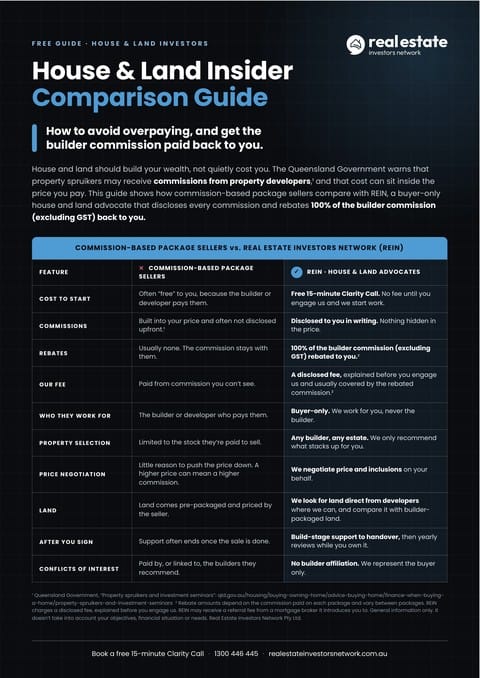
Ask the person selling you the package, in writing, whether any commission, marketing fee or other payment comes out of the price, and who receives it. NSW Fair Trading suggests asking anyone acting for you as a buyer’s agent whether they receive any rebates, discounts, commissions or other benefits from third parties.
Our guide to builder commissions explains what to ask and why the answer matters for the price.
How REIN Can Help Before You Sign
REIN acts only for the buyer. Send us the package and we’ll:
- check the land price against recent sales of comparable lots
- go through the specification, allowances and site costs
- compare the total with sold new homes nearby
- test the rent against official medians
- find out who is paid from the price, and how much
How we’re paid: a disclosed fee, and 100% of builder commission (excluding GST) rebated to you.
Common Questions About Overpriced House and Land Packages
How do I know if a house and land package is overpriced?
Check the land against recent sold land in the same estate, read the build specification for allowances and exclusions, and compare the total with sold new homes nearby. Then test the rent against official medians and ask who is paid from the price. If two or more of those checks come back high, get the package reviewed before you sign.
Is the land or the build more likely to be overpriced?
Either can be. Land is easier to test because sold lots in the same estate are public. The build is harder because inclusions, allowances and site costs vary from one builder to the next, so you have to compare specifications, not just prices.
Will the bank valuation tell me if I’m overpaying?
Only after the fact. The valuation is done for the lender, and for a new build it is often based on your signed contracts and plans. If it comes in under your price, you may need more deposit or equity to make up the shortfall.
Are brochure rents reliable?
Treat them as estimates. In Queensland, compare them with the RTA’s median weekly rent for the same postcode and property type, which is based on new bonds lodged each quarter.
Can I negotiate an overpriced package?
Sometimes. You may get a lower price, better inclusions or fixed site costs. Our guide to negotiating a house and land package covers what tends to move.
Not sure your package stacks up?
1. Send us the package. 2. We check the land, the build, the rent and who is paid. 3. We tell you straight whether the price holds up.
Get My Package Checked → or Book a 15-Minute Clarity Call or call 1300 446 445
Comparing house and land packages right now? REIN sits on the buyer’s side of the contract and checks the price before you commit. Browse more guides on the REIN blog.
More guides
- Are House and Land Packages a Good Investment?
- What to Check Before Signing a House and Land Contract
- Split Contract vs Single Contract House and Land
- Rental Yield on House and Land
- Builder Commissions: What to Ask
- How to stress-test a house and land investment
- Buying a second investment property
Written by Tom Ashby for REIN. Fact-checked against the sources below. Last updated 16 November 2026.
Important disclaimer: This article is general information only, compiled from publicly available sources on the internet. We believe it was accurate at the date of publication, but details change and errors can occur. It is not legal, tax, financial or credit advice and does not take your circumstances into account. The yield table uses illustrative figures, not a forecast. Before you rely on anything here, confirm the facts directly with the builder, developer, lender or government agency concerned, and speak to your accountant, solicitor or licensed adviser. REIN accepts no liability for decisions made on the basis of this article. To report an error, call 1300 446 445.
Sources
- Westpac: Understanding bank valuations, accessed 16 November 2026.
- Opteon: What documentation do you need to support a construction loan? (25 August 2015), accessed 16 November 2026.
- QBCC: Domestic building contracts, accessed 16 November 2026.
- Residential Tenancies Authority: Median rents quarterly data, accessed 16 November 2026.
- NSW Government: Using a real estate agent to buy a property, accessed 16 November 2026.
More on tax and finance